

The Trump administration is continuing it’s war on climate science. This time, instead of attacking climate science in general, as they tried (and failed) to do with the DOE Climate Working Group, they are going after the U.S. National Climate Assessment (NCA).
The NCA is required at least every four years under the 1990 Global Change Research Act and it serves as the evidentiary basis for a lot of government climate planning in the U.S. Because of this, it’s frequently attacked by the Merchants of Doubt and weakening it is a clear goal of this administration.
There was some chatter that the administration would try to write an entire new version of the NCA that would deny well-established climate science, but my guess is that they have abandoned this. The NCA is a “Highly Influential Scientific Assessment” and therefore must follow specific rules. These include rules about how to select authors, peer review, etc. Following those rules would make it impossible to produce the biased, climate-denying report that they require. And if they don’t follow the rules, they’d lose the inevitable court challenges.
So they instead, they are proposing to amend the Fifth National Climate Assessment (NCA5) by (basically) removing references to the highest emissions scenarios, RCP8.5/SSP5-8.5, which produces the most warming:

This is justified on two grounds: 1) RCP8.5/SSP5-8.5 is not an expected emissions scenario and 2) it is not policy relevant. Point 1 is irrelevant since the NCA5 does not refer to it as business as usual, baseline, etc. And Point 2 is just wrong. My comment below expands on these points.
The USGCRP is presently soliciting comments. You can tell USGCRP understands their arguments are weak since they go out of their way to make it as hard as they can for people to comment on it: They’re limiting the comment window to 15 days and comment length to 3,500 words.
Below is my comment on this. If you see any errors, please leave a comment below or email me.
Public Comment on the Proposed Amendment to the Fifth National Climate Assessment
Summary
I write to oppose the proposed amendment. It should be rejected in its entirety.
The amendment rests on two false premises: 1) that NCA5 presents RCP8.5 and SSP5-8.5 results as expected, baseline, or business-as-usual futures, and 2) that RCP8.5/SSP5-8.5 scenario runs are not useful for policy deliberations. As described here, neither of these premises is true.
First, NCA5 accurately describes RCP8.5/SSP5-8.5 as very high emissions scenarios throughout the report. Second, because of uncertainty in many climate parameters (e.g., climate sensitivity), the temperatures produced under RCP8.5/SSP5-8.5 are a reasonable upper bound on what the future climate might be. These scenarios are therefore worth examining not as expected outcomes but as plausible worst cases. Eliminating RCP8.5/SSP5-8.5 therefore commits one of the cardinal sins of risk assessment: assuming the worst-case will not occur.
In addition, NCA5 frequently uses these scenarios in global-warming-level analysis, which evaluates impacts at different levels of warming but makes no claim about how likely any level of warming is.
Overall, removing RCP8.5/SSP5-8.5 analyses would strip sound science from the assessment and make it harder for U.S. policymakers to evaluate the risks of climate change.
1. NCA5 does not present results with RCP8.5 or SSP5-8.5 as business-as-usual
The term “RCP8.5” and “SSP5-8.5” appear 113 times in NCA5 — 74 mentions of “RCP8.5” and 39 of “SSP5-8.5”. I have inventoried all of them. They appear in 98 passages. Eighty-four of those describe the pathway as a very high scenario and six as a high scenario; the remaining eight carry no descriptor in the sentence itself. NCA5 never refers to RCP8.5 or SSP5-8.5 as business-as-usual or anything similar. Thus, NCA5 already labels the scenario correctly.
2. RCP8.5/SSP5-8.5 emissions may be implausible, but temperatures are not
Much of the RCP8.5 discourse misses a key point: in trying to understand future climate changes, our focus is not primarily on emissions. Rather, it is on temperature, which is what drives most climate impacts. So the key question is: are the temperatures predicted by today’s climate models driven by RCP8.5 implausible?
To quantify this, I ran the FaIR climate emulator (v2.2.4, Leach et al., 2021) between 1750 and 2100 under SSP2-4.5 and SSP5-8.5 emissions from RCMIP v5.1.0. Climate-response uncertainty was represented by the 841-member calibrated and constrained parameter ensemble of fair-calibrate v1.4.1. This analysis shows that the warmest of the SSP2-4.5 runs reach the median SSP5-8.5 run (Figure 1).
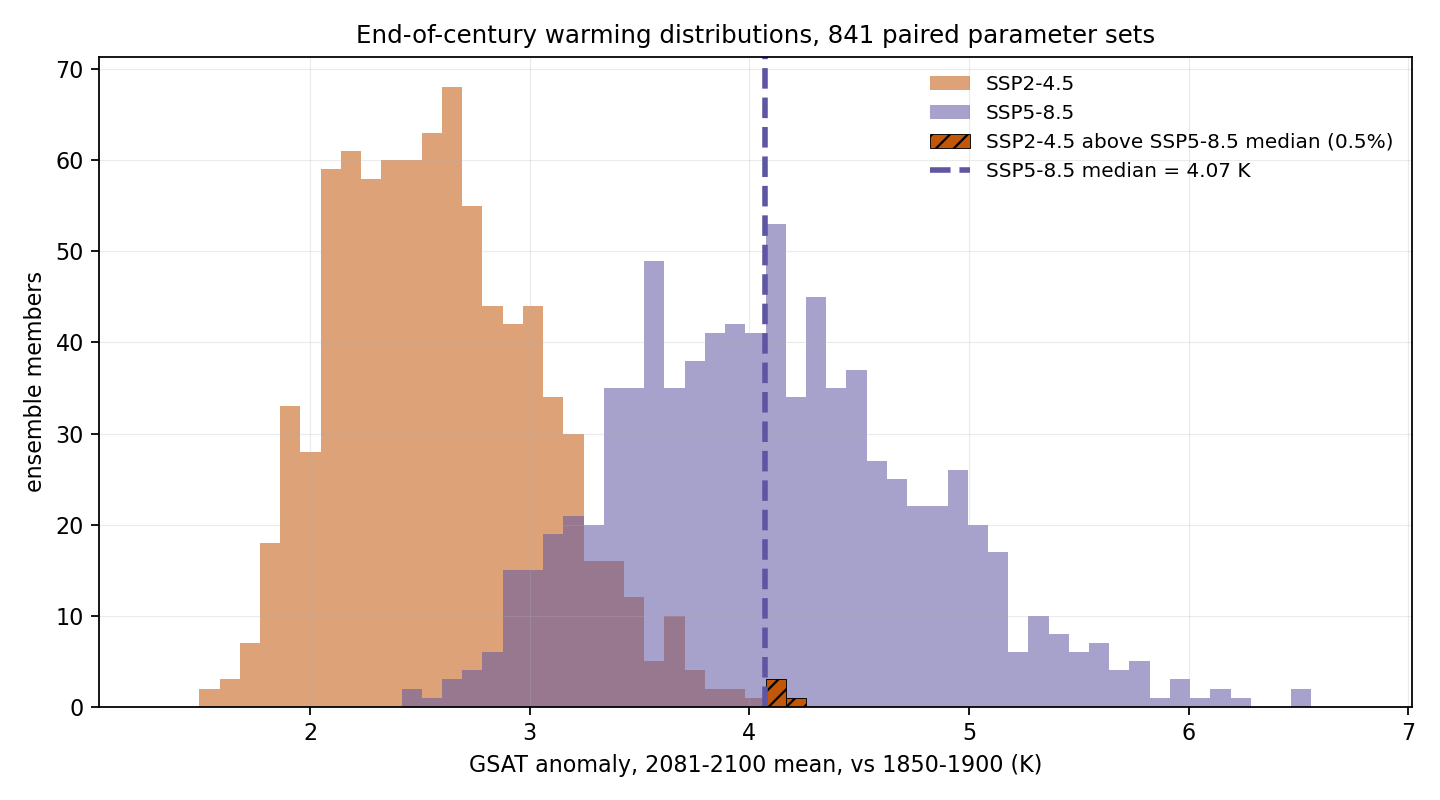
Let me be precise about what this result means. The spread within each scenario in Figure 1 is not noise. Each of the 841 parameter defines a plausible set of uncertain parameters that determine how the climate system responds to emissions: how sensitive it is to carbon dioxide, how quickly the ocean takes up heat, how strongly aerosols cool, how the carbon cycle responds, etc. Because the ensemble was constrained against observations, every one of these descriptions is consistent with the warming observed to date.
The real climate system, of course, has one true set of these properties. This analysis shows that we cannot rule out that the real climate system driven by a SSP2-4.5 emissions delivers warming at the end of the century equal to what a typical model produces under SSP5-8.5 (around 4°C).
The median temperatures in the RCP8.5/SSP5-8.5 ensemble are therefore plausible, even if the emissions that produced them are not. As discussed in the next section, this is important for risk assessment.
One might reasonably wonder why we need SSP5-8.5 to estimate the upper limit of SSP2-4.5 runs. Why can’t we just use SSP2-4.5 runs to evaluate the upper limit? You certainly could specifically analyze high-sensitivity models driven by SSP2-4.5 to determine the worst-case scenario, but the available literature doing that is sparse compared to the literature describing RCP8.5/SSP5-8.5 results and doing that would require a wholesale revision of the NCA5 that is not being considered here.
Keeping the RCP8.5/SSP5-8.5 runs as a plausible upper limit is particularly important given that recent research has emphasized the possibility that models are underestimating future warming. Gyuleva et al. (2026), for example, use the Earth’s energy imbalance to suggest that models with higher transient climate response more accurately fit the planetary energy balance observations of the last few decades. Armour et al. (2024) show further that the strongest evidence against high-sensitivity models, their poor reproduction of the warming since the 1970s, does not actually rule those models out.
In addition, the SSP2-4.5 scenario contains enormous amounts of carbon removal (Anderson & Peters, 2016). In 2100, for example, total carbon capture & sequestration (CCS) in that scenario is 32 GtCO2[1]. Our willingness and ability to implement CCS at this level (about 75% of today’s total CO2 emissions) is entirely hypothetical (Daigle & Ravikumar, 2026). It is therefore possible that we will not do so, meaning that SSP2-4.5 will be understating emissions. This would push SSP2-4.5 temperatures even further into the range of temperatures simulated by RCP8.5/SSP5-8.5.
Thus, the median global temperature predicted by today’s models driven by RCP8.5/SSP5-8.5 is a plausible upper limit of warming this century. To the best of my knowledge, there is no analysis that opposes this conclusion and I do not believe the case can be made on current evidence. The proposed amendment does not attempt it.
3. Risk assessment should not confine itself to the most likely outcome
Reaching RCP8.5-level temperatures with SSP2-4.5 emissions, while plausible, is not likely. But that does not mean we should ignore it. In fact, conventional risk management tells us that, when consequences are severe, low-probability extreme outcomes can determine the response.
Levees are built to withstand the hundred-year flood, not the average year. Nuclear power plants’ safety systems are designed against worst-case scenarios, not average operations. Insurance companies maintain solvency by accounting for the worst-case claims scenario, not typical scenarios. In the national defense arena, Vice President Cheney famously said that, if there is a one percent chance that Pakistani scientists are helping al-Qaeda build a nuclear weapon, “we have to treat it as a certainty in terms of our response.”[2]
It is in this role that RCP8.5/SSP5-8.5 is valuable: as a plausible upper bound of the temperature distribution given SSP2-4.5 emissions. This contradicts the claim in the amendment that RCP8.5/SSP5-8.5 is not policy relevant. In fact, adopting this amendment would mean that our risk assessment would ignore tail risk. This would go against best practices of risk assessment. I also note that the amendment presents this as a correction of a scientific error, when in reality it’s a value judgement about what role upper limit risks should play in deciding how to respond to climate change.
4. Global warming levels
The amendment also ignores other ways the NCA5 uses RCP8.5/SSP5-8.5. In many places, NCA5 does not use RCP8.5/SSP5-8.5 as a possible emissions trajectory but to predict impacts at various global warming levels (GWLs). In other words, the analysis estimates the climate impacts when the planet is 2°C, 3°C, or 4°C warmer than preindustrial.
For example, Figures 2.9, 2.10, and 2.13 map U.S. temperature, precipitation, and sea surface temperature at 1.5°, 2°, 3°, and 4°C of global warming; Figures 2.11 and 2.12 map extreme heat and extreme precipitation at 2°C; Figures 1.14 and 1.15 in the Overview and Figure 30.3 for the Pacific Islands do the same. The report’s findings are read off these figures: e.g., at 2°C of global warming, U.S. average temperature very likely rises 4.4°–5.6°F (p. 2-21), tropical cyclone winds are 5% faster (p. 2-26), and Midwest extreme precipitation intensifies by 10%–15% (p. 24-19).
None of these are predictions that these temperatures will occur. Rather, they answer a different question: what happens when the climate reaches that temperature.
The amendment’s plausibility argument does not address this alternate use and it performs none of the analysis needed to separate warming-level results from genuinely emissions-dependent ones. It simply declares RCP8.5/SSP5-8.5 off-limits, which could be used to strike the GWL analysis from the NCA5. It offers no justification for discarding RCP8.5/SSP5-8.5 scenarios in GWL analyses, which is of value even if reaching the top of the temperatures range is unlikely.
Recommendation
Reject the proposed amendment in its entirety.
The amendment fails to correct any errors in the NCA5 and is inconsistent with the underlying science. First, NCA5 accurately describes results with RCP8.5. Second, the amendment declares RCP8.5/SSP5-8.5 off-limits to federal decision-making but doesn’t address the fact that the median temperatures predicted from these scenarios is plausible. Third, it presents an institutional judgment about risk tolerance (that we should ignore worst-case scenarios) as though it were a scientific correction. Fourth, it proposes to jettison research about impacts at global warming levels. Thus, adopting the amendment would leave the country less prepared for future climate impacts, including lower probability but high severity outcomes.
Anderson, K., & Peters, G. (2016). The trouble with negative emissions. Science, 354(6309), 182-183, doi:10.1126/science.aah4567
Armour, K. C., Proistosescu, C., Dong, Y., Hahn, L. C., Blanchard-Wrigglesworth, E., Pauling, A. G., Jnglin Wills, R. C., Andrews, T., Stuecker, M. F., Po-Chedley, S., Mitevski, I., Forster, P. M., & Gregory, J. M. (2024). Sea-surface temperature pattern effects have slowed global warming and biased warming-based constraints on climate sensitivity. Proceedings of the National Academy of Sciences, 121(12), e2312093121, doi:10.1073/pnas.2312093121
Daigle, H., & Ravikumar, A. (2026). Can we sequester carbon fast enough? Growing disconnect between models and reality. Environmental Research: Energy, 3(3), 031001, doi:10.1088/2753-3751/ae987b
Gyuleva, G., Fischer, E., Knutti, R., & Sippel, S. (2026). Recent Temperature and Energy Imbalance Trends Point to Higher Estimates of Future Warming. Earth’s Future, 14(8), e2026EF008356, doi:10.1029/2026EF008356
Leach, N. J., Jenkins, S., Nicholls, Z., Smith, C. J., Lynch, J., Cain, M., Walsh, T., Wu, B., Tsutsui, J., & Allen, M. R. (2021). FaIRv2.0.0: a generalized impulse response model for climate uncertainty and future scenario exploration. Geosci. Model Dev., 14(5), 3007-3036, doi:10.5194/gmd-14-3007-2021
Related posts
Marcus Sarofim has posted his comment on this amendment. It’s good.
Here at TCB, we’ve written a lot about RCP8.5/SSP5-8.5. Here are a few of them:
[1] Retrieved from the IIASA SSP database.
[2] Quoted in Ron Suskind’s book, The One Percent Doctrine, published 2006.
In your summary you use straw men when a better approach is suggested.
You say,
"The amendment rests on two false premises: 1) that NCA5 presents RCP8.5 and SSP5-8.5 results as expected, baseline, or business-as-usual futures..."
I would change it to,
"The amendment rests on the false premise that NCA5 presents RCP8.5 and SSP-8.5 as ** anything other than ** an illustrative, potentially worst case, scenario for comparison with the other scenarios..."
Thank you for presenting these important arguments!