

There is a PR campaign underway against extreme event attribution, the science of determining how much human-caused climate change contributed to a particular heat wave, flood, or storm.
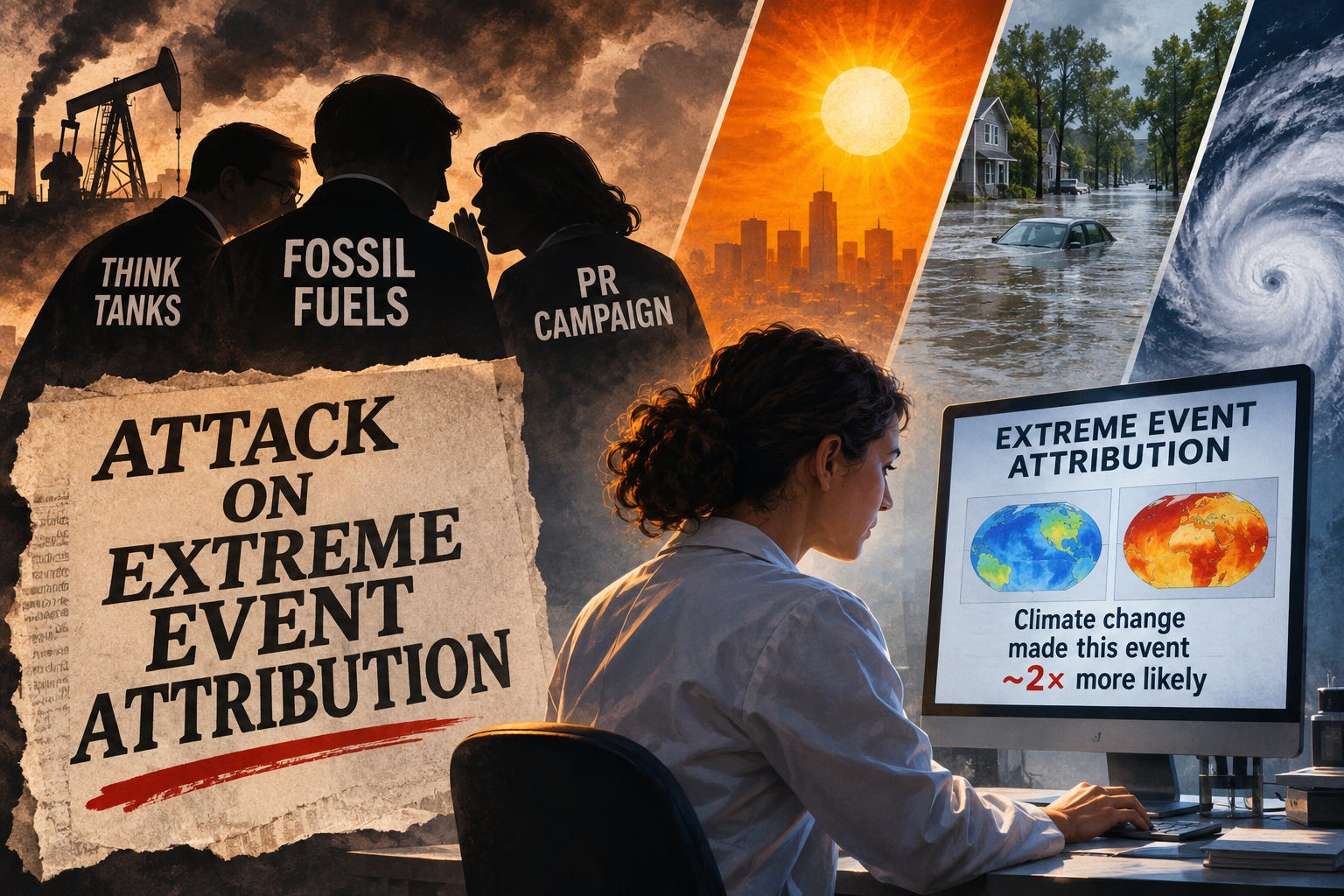
Everybody should understand what’s going on here. Fossil fuel interests and their proxies are attacking extreme event attribution because it’s a threat to their business model. Their goal is simple: they are trying to maintain their social license to dump carbon into the atmosphere.
Background on the science
For a long time, the standard line from climate science was that you can’t attribute any single event to climate change. That was fine with fossil-fuel interests because, when damaging extreme weather occurred, they could argue: “Sure, climate change is real, but you can’t say anything about this particular storm that flooded a city. So we bear no responsibility.”
That began to change in 2003, when Myles Allen published a commentary in Nature titled Liability for Climate Change, floating the idea that we might someday be able to say how much human influence had changed the odds of a particular event.
A year later, Stott et al. published the first study of this kind, concluding that human influence had at least doubled the probability of the 2003 European heatwave, which killed tens of thousands. Two decades on, attribution studies are routine, and they can often be done within days of an event.
In July, the National Academies of Sciences (NAS) released a report on extreme event attribution, concluding that the methods have improved considerably, with the most confidence for extreme heat and heavy rainfall.
If you’re interested in learning more about this field, read this post I wrote a few months ago on the topic.
The pushback
When the report came out, there was a concerted effort by climate misinformers and their enablers to slime the report and the entire field more generally. These arguments are mainly personal attacks on scientists and accusations that scientists are pushing a political agenda.
There is almost no actual critiquing of the science.
A good example is a video from a popular science communicator, Dr. Sabine Hossenfelder. I’ve seen a number of Hossenfelder’s videos and generally like them. For example, I really liked her video on John Clauser, the Nobel Prize–winning physicist turned climate skeptic. She took Clauser’s arguments head-on and explained clearly where they go wrong.
Which is why her new video on extreme event attribution is so disappointing. She misses the boat here by attacking scientists’ motivations and crediblity rather than substantially engaging with the science.
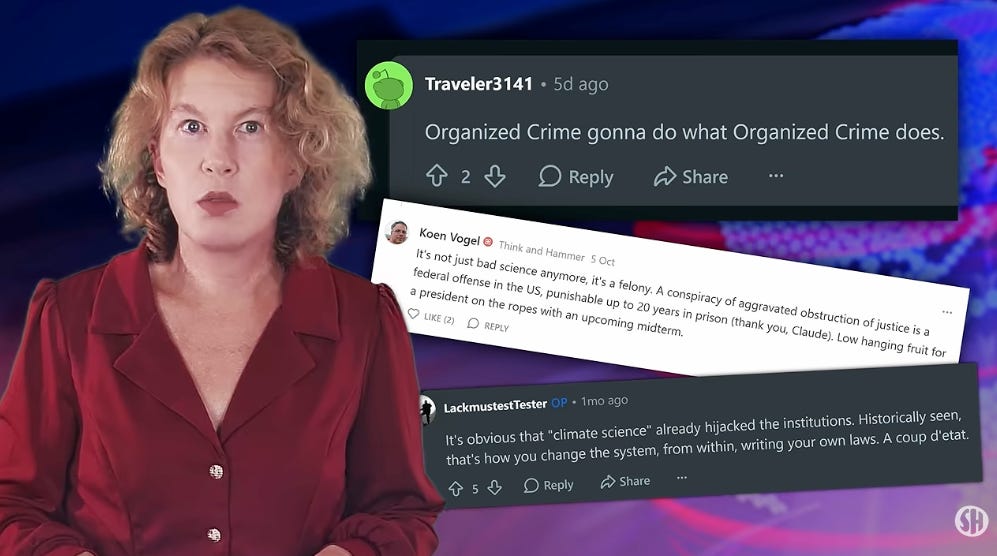
She starts with some quotes from people on reddit, as if that’s proof of anything. Seriously, you don’t believe the National Academies but you do believe literal internet randos.
She also quotes a news article from the late 2010s where a prominent scientist working on extreme event attribution, Dr. Fredi Otto, says that she often talks to lawyers about the science.
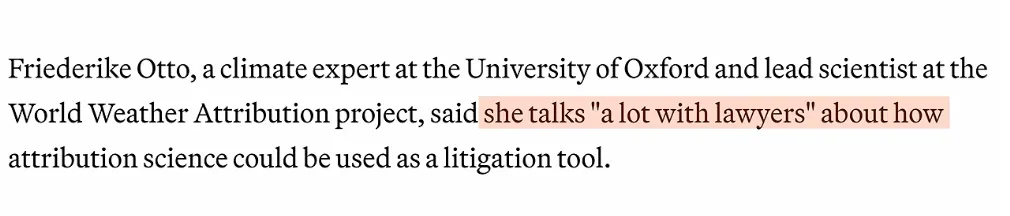
This is, Hossenfelder implies, a gotcha. Otto talks to lawyers. You don’t know what she tells them, but I suppose it looks bad.
She also quotes a string of prominent critics but never tells her viewers who these people are. Let me fill you in.
Steven Koonin is a senior fellow at the Hoover Institution at Stanford, an extreme right-wing think tank and a well-known source of climate disinformation. Koonin also spent five years as the chief scientist of an oil company, BP. Roger Pielke Jr. is affiliated with the American Enterprise Institute, another right-wing Washington think tank.
Koonin and Judith Curry were two of the five people hand-picked by Energy Secretary Chris Wright to write the Department of Energy’s climate report last year. It is a deceitful report that was basically fossil fuel propaganda.
She also cites a letter from 25 Republican state attorneys general as evidence about attribution science. Normally, I would assume that anyone citing Republican politicians on the validity of climate science was being ironic, but I don’t think that’s the case here.
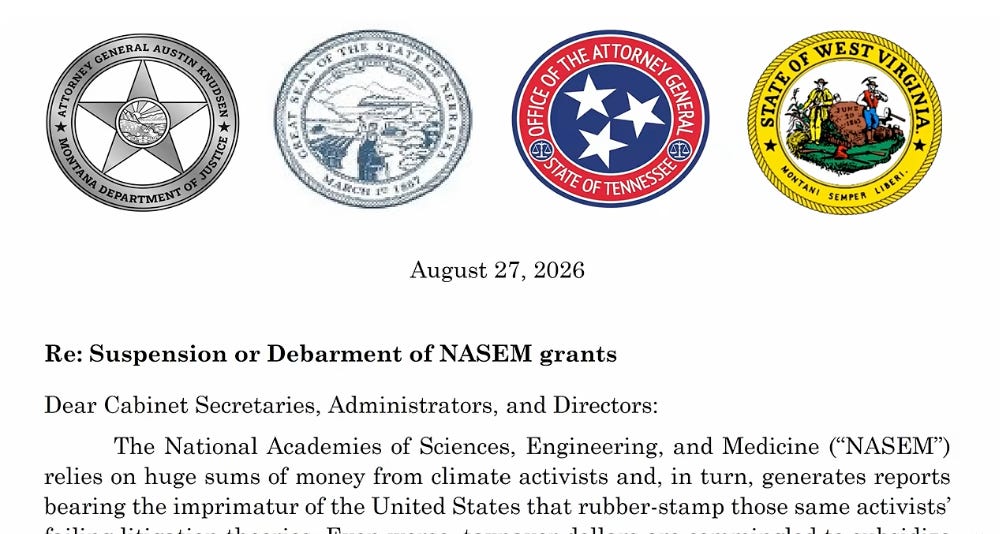
Hossenfelder never mentions that these conflicts are IMHO much larger than Otto’s talking to lawyers. That seems like a pretty big problem with her video.
The science, such as it is
Let me repeat: almost all of the arguments against extreme event attribution are like this. They rarely address the science, because the science is not that complicated. Instead, they spin conspiracy theories about scientists doing the analysis.
We should stop criticizing people for their affiliations or who they talk to and start critiquing their scientific arguments (or lack thereof).
For example, Hossenfelder does eventually make a scientific argument. About four minutes in, she says:
My main beef is though that the probability you get will depend on how you define the event. The more details you add about the event, the less likely it will become until eventually you are comparing zero to zero. There is pretty good evidence that climate change does impact trends of certain extreme events. But making definite statements about the counterfactual probability of a particular event not occurring is, in my opinion, ill-defined mathematical nonsense. There is no amount of equations that will make this fundamental problem go away. It’s not that I think climate change doesn’t happen or that I think it’s not man-made or that we shouldn’t worry about it. I think this event attribution business is bad maths.
Wait, what? To me, this argument amounts to “it doesn’t sound right, so it’s wrong.” I call this vibes-based science.
It’s the same reasoning you hear from climate deniers who say that carbon dioxide going from 0.03% of our atmosphere to 0.04% can’t possibly affect our climate because it’s such a small number.
It’s basing science on how it feels, not on actual physics.
So here’s my challenge to Hossenfelder and everyone else: Stop attacking scientists and focus on the science.
If Hossenfelder thinks that these studies don’t define the events correctly, then please give me an example. There are lots of papers out there, so find one and explain how they’ve defined the event in such a way that they are guaranteed to get one particular result.
Maybe Hossenfelder can make a good argument. If so, I welcome it. This is how science works. People publish, other people criticize, and the science gets better. But the focus has to be on the science, not on whether a scientist talked to a lawyer.
The true heroes & the true conspiracy
Attribution science is a new field and it is rapidly advancing. I think the people working in this area (not me, by the way) are heroes. They are putting up with harassment by fossil fuel interests and having their credibility impugned by some of the worst people in the world.
Anyone paying attention should recognize the playbook being run here. We’ve seen it before with tobacco, and there are entire books documenting how it works. The strategy is simple: libel the scientists, exaggerate uncertainties, and convince the public that the science is too unsettled to justify action.
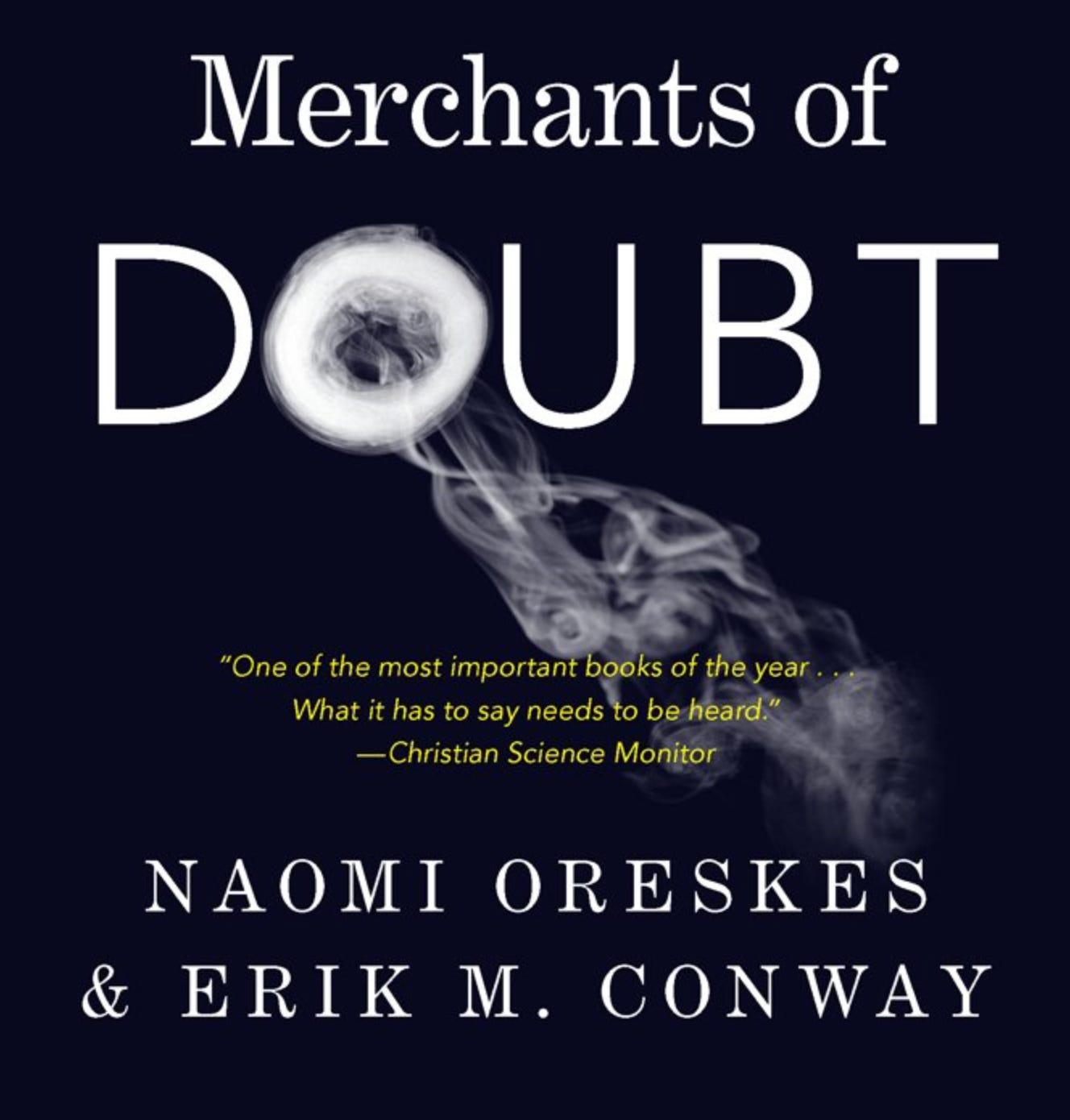
Exactly what we see today happening to extreme event attribution science.
This doesn’t mean attribution science should be immune from criticism. Scientific scrutiny is a key part of science. But these are not good-faith scientific criticisms. Instead, it’s a campaign to undermine science and boost powerful economic interests.
The tobacco playbook worked for decades. Fossil-fuel interests are betting it will keep working. Don’t fall for it.
I have my finger on the block button for anyone to misrepresents what I said. Read my post carefully and think before posting.
Hossenfelder's brand is contrarianism and negativity. Sometimes that's useful in science. Often it's not. But it's usually good for clicks.