

Today more than 2,000 gigawatts of new power plants and batteries are waiting in line to connect to America’s electric grid. That is more than the capacity of every power plant now operating in the country, and about 85% of it is solar, wind and storage. Projects that came online in 2025 typically spent around 61 months in line waiting to be approved, up from 36 months in 2015.
For most of my career as a climate scientist, the main obstacle to cutting our emissions of carbon dioxide and other greenhouse gases was the cost. But over the past decade clean energy has become dramatically cheaper. The problem has shifted to building it, and sending the electricity where it is needed. The United States built only 411 miles of new high-capacity transmission lines in 2025, less than we managed a decade ago and a fraction of the roughly 5,000 miles a year that analysts estimate we need in deep decarbonization scenarios. A bipartisan permitting bill now moving through the Senate would start to fix these problems. Senators voted 73 to 25 last week to take it up, and a final vote is expected in the coming days.
Addressing climate change takes more than using less dirty energy; it requires building an enormous amount of clean energy at an unprecedented pace. We will need to replace most of the fossil fuels we burn in our homes, cars and factories with electricity. That means producing far more electricity, and most scenarios have the US roughly tripling its current generation. We cannot dramatically expand the grid with the five-year wait times and anemic transmission growth we see today.
The Bipartisan American Affordability and Jobs Act (BAAJA) attempts to address these bottlenecks. If a state does not take action on a transmission application for more than a year, federal regulators can step in and permit the line. Grid regions must plan lines with their neighbors, and grid operators must study connection requests faster, helping unclog the queue. Agencies can no longer revoke a permit once issued without clearing a high bar of evidence. These rules, along with requirements to speed up decision-making, would make it much harder for any future administration to hold up the approval of new clean energy projects the way the Trump administration has.
The bill is far from perfect
The BAAJA permitting reform bill was introduced by two of the Senate’s most outspoken climate champions – Sheldon Whitehouse and Martin Heinrich – as well as two of their Republican colleagues Shelley Capito and Mike Lee. As such it represents a bipartisan compromise, and includes parts that will make neither side happy.
While the bill makes it easier to build clean energy, it also makes it easier to build fossil fuels, particularly natural gas infrastructure. The bill exempts the expansion of existing gas pipelines from environmental review and narrows states’ ability to block pipelines under the Clean Water Act. It limits lawsuits in ways that will make it harder for communities to challenge projects of every kind – clean and dirty. And if court that finds that an environmental review was flawed could only send it back to the agency while the permit stays in effect, so a mine or drilling project approved on a bad review could keep going while the agency redoes its review.
The revised text the was released last week made some notable improvements to the bill. It clarifies that the permit protections do not limit the power of courts to issue injunctions, and it narrows the national security exception that the Trump administration used on to justify blocking offshore wind. It also adds an exception for agency actions “taken pursuant to any applicable law or regulation,” which supporters of the bill read as covering any new pollution rules (but some critics call too vague to rely on).
Even accounting for these issues in the bill, faster and more durable permits will matter far more for clean energy than for fossil fuels. About three-quarters of US oil and nearly nine-tenths of its natural gas come from private and state land and waters where federal permits only play a small role. Clean energy is the opposite: nearly every offshore wind farm sits in federal waters, and the federal government owns 46% of the land in the 11 Western states that are home to the country’s best solar resources. Wind and solar farms also cover vastly more ground than a gas plant, and new transmission lines cross hundreds of miles and multiple states and in turn need more approvals from regulators.
It will modestly reduce emissions – but also pave the way for more ambitious policy
Two independent modeling groups have now taken a look at the bill, and both find that it will reduce US emissions. Rhodium Group, which modeled the pipeline provisions as well as the grid reforms, found that the bill would lower US emissions in every scenario it examined, by between 5 and 148 million tons in 2040 (or up to 4% of US emissions). Resources for the Future, which looked only at the power sector impacts, found that the bill would lower emissions by about 6% by 2041.
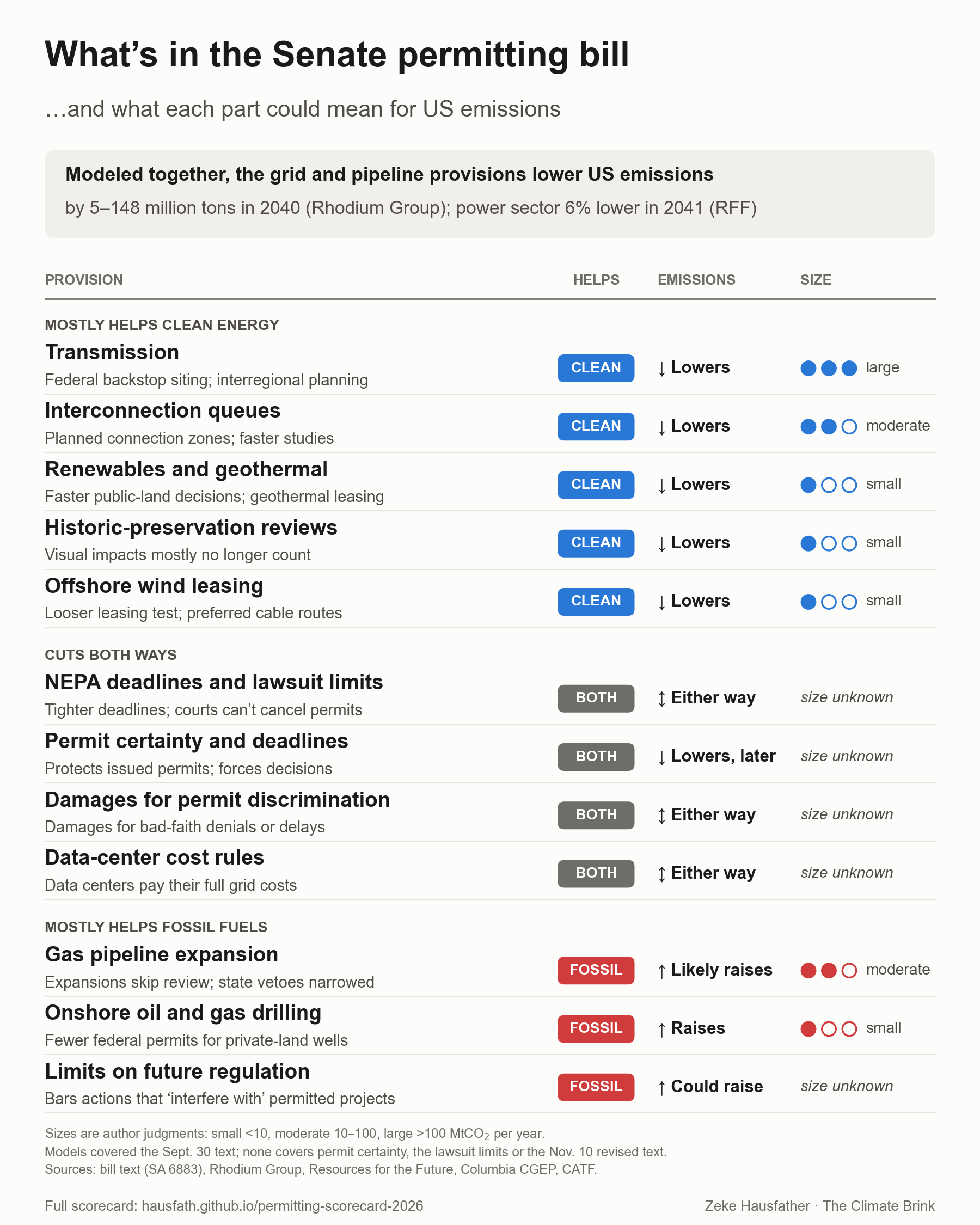
The main provisions of the Senate permitting bill, who they mostly help today and their likely effect on US emissions. A more detailed version of this graphic with sources for each row is available here.
The bill also has important impacts on the wave of new data centers being built today. Many data center developers currently plan to skip the grid and build their own gas plants on site, in part to avoid long waits for a grid connection. As I found in an earlier analysis, the engines and turbines most of them plan to use emit 60 to 80% more per unit of electricity than the grid does. By speeding up grid connections and new transmission, the bill should make it easier for data centers to connect to the grid and avoid reliance on dirtier and more expensive off-grid generation. The bill also requires data centers to pay the full cost of the grid service and upgrades built for them, so that other ratepayers do not end up covering those costs.
The BAAJA permitting reform bill is best thought of not as a climate bill per se, in that it will not drive substantial emissions reductions by itself. But it will set the stage for climate policy enacted by the next US administration to be much more impactful. The bill removes many of the obstacles that could stop a future administration from undertaking more ambitious climate action. A president who wants to build clean energy fast would inherit federal backstop siting for transmission, interregional planning, enforceable review deadlines and lawsuit limits that cover clean energy projects, along with approvals a successor could not easily revoke. As a recent Columbia University analysis put it, removing these barriers “can make stronger climate policies less costly and more effective in the future.”
But the bill may do less to restrain the current administration. A Clean Air Task Force analysis of the revised text concluded that the permit protections “may have little deterrent effect” on its efforts to block wind projects. Most of the climate benefits will come under whoever follows President Trump.
Why not just wait for the next Congress?
This month’s elections represented a sea change in US politics. Democrats will control both chambers of Congress in January, with over 255 House seats and (very likely) 56 seats in the Senate. A number of Democrats including Rep. Jared Huffman and Sen. Jeff Merkley have argued that the party should wait and try to write a better bill next year.
But a new Congress does not change who ultimately needs to sign bills into law. President Trump will be in office until January 2029, and before the election he was explicit about what he would do with legislation from a Democratic Congress: “veto everything”. A permitting bill written mostly by Democrats, with the pipeline provisions stripped out and stronger protections for wind and solar seems about as likely a candidate for a veto as any that I can think of. Overriding a veto takes two-thirds of both chambers, which would mean finding around 35 House Republicans and 11 Republican senators willing to defy Trump to pass a Democratic-led permitting bill.
Even setting the veto aside, the Senate math does not change all that much. Permitting legislation will still need 60 votes in the Senate next year, and therefore the support of at least four Republicans. A bill that can clear that bar and earn a presidential signature would likely end up looking a lot like this one.
And we have unfortunately seen this process play out before, with the result being additional stasis and gridlock on permitting. In December 2024 a bipartisan permitting bill from Senators Joe Manchin and John Barrasso died in the lame duck session. Republicans had just won the White House and both chambers of Congress, and planned to pass something more to their liking along party lines the following year. Manchin warned at the time that permitting reform “will continue to be subject to the Senate’s 60-vote threshold next year.” Meanwhile the country has gone two more years without fixing the problems holding back clean energy development and transmission expansion.
Realistically, the choice is between this bill now and a hypothetically better one in 2029 at the earliest. And that will only happen if Democrats win the presidency, hold both chambers and can still find 60 votes in the Senate. When it comes to climate change, delays matter. The bill gives federal regulators 18 months to write new rules for connecting projects to the grid, and gives grid regions two more years to comply. Big transmission lines take around a decade on average to plan, permit and build. If the BAAJA bill passes now, the new rules will be in force by around 2030. If we cannot pass permitting reform until 2029, we won’t be able to build the infrastructure we need until closer to 2033. Passing this bill now is a much better bet than waiting for a better one that may never come.
This is ultimately not the bill that I or many climate advocates would have written. But politics is often the art of compromise, and making the perfect the enemy of the good is a recipe for preserving the status quo. Every year a solar farm spends waiting in line to connect to the grid is a year a gas or coal plant runs in its place. We’ve already succeeded in making clean energy cheap. Now we need to ensure that we can actually get it built.
It’s disappointing to see political assessments like this one that are so incomplete and far from the reality on the ground. Is the best course to give up any negotiations in the next Congress, and bow to the wishes of Trump even after the mandate against him and his policies that the American people just delivered?
Why roll over to take such a bad deal as BAAJA now when it’s the worst version of what could be achievable as law?
Should we really believe that giving Trump and his administration very broad authority to fast track harmful projects of ALL types (not just energy) while preventing future administrations from reconsidering them even where they were authorized illegally is the only deal possible? This is what the manager’s amendment includes, not just the original draft. Read the White House press releases - they are salivating at the possibility Democrats could be so weak and gullible as to pass BAAJA now.
Shouldn’t we at least take the time to work on fixing issues like this in the next Congress?
Next session there is a good chance at veto-proofing something with a much better balance of gives and gets than BAAJA, and a very high chance of something better in at least some areas.
Those of you who are enthusiastic about passing this bill are ignoring this: having energy facilities on our public lands will destroy natural systems. The only reason this can claim to be a benefit in a climate equation is because we are not giving our forests, grasslands and other natural systems enough credit for all the hard work they do, including in pulling down carbon dioxide.
So why should we destroy living systems to support artificial ones? We all know the new energy is going for AI data centers. With the latest Nvidia scandal, the chances of an AI bubble are bigger than ever.
The important question is, why are we destroying the living world and decimating future human jobs to support an artificial one?