

I am finalizing a textbook on climate risk and am posting chapters as I finish them. I’d previously posted chapters about embedded energy and physical climate risk; this post is a chapter on transition risk, the economic and social risks of the transition to a clean-energy economy.
Introduction
In the context of climate risk, transition risk encompasses the economic and social risks associated with a shift towards a low-carbon economy. Such an effort would fundamentally reshape our world and create critical financial uncertainty for assets and industries tied to the old, carbon-intensive system.
Net zero
Reaching “net zero” is the ultimate goal of most climate policy. This means reducing greenhouse gas emissions as much as possible, with any remaining emissions that are too difficult or costly to eliminate are canceled out by an equivalent amount of “negative emissions” — processes that actively pull carbon dioxide out of the atmosphere. These negative emissions are the “net” part of net zero and it acknowledges the practical reality that some sectors, like long-distance air travel or ocean shipping, may be incredibly difficult to decarbonize in the near future.
What are these negative emissions technologies? The two primary methods discussed are Direct Air Capture (DAC), which uses machines to filter carbon dioxide directly from the air, and Bioenergy with Carbon Capture and Sequestration (BECCS), which involves growing crops, burning them for energy, and capturing and burying the resulting carbon dioxide. However, both technologies face significant hurdles, including high costs, large energy requirements, and, in the case of BECCS, immense land use needs that could compete with food production and biodiversity.
Once we reach net zero, global temperatures will stabilize — although they won’t recover to pre-industrial levels for tens of thousands of years. Getting the climate to actually cool on time scales we care about (decades to centuries) would would require pulling even more carbon dioxide out of the atmosphere, or deploying some type of climate engineering approach like injecting aerosols into the stratosphere.
The scale of the net zero transformation means that reaching net zero will fundamentally overhaul vast parts of the global economy. Many big sectors of our economy — energy, transportation, industry, agriculture — must be reshaped, and that reshaping will create enormous opportunities as well as painful dislocations. The transition to a low-carbon economy is not simply a matter of swapping one energy source for another; it requires rebuilding infrastructure, retraining workers, and redirecting trillions of dollars in investment.
Some industries are poised to prosper. Renewable energy is the most obvious example: in 2025, the world added over 700 GW of new capacity, and sustaining that pace for decades will require ongoing investment in manufacturing, installation, and maintenance of wind turbines and solar panels. The profits for those well positioned will be enormous.
The electric vehicle industry and its supply chains — from battery manufacturers to mining operations for lithium and cobalt — also stand to grow dramatically. Companies that build and manage electrical grid infrastructure, including new transmission lines and energy storage systems, will see surging demand. So too will firms specializing in energy efficiency, building retrofits, and emerging technologies like green hydrogen and sustainable aviation fuels. Even agriculture could see new revenue streams as farmers are paid to adopt practices that sequester carbon in soil.
Other industries, however, face serious decline. Fossil fuel producers (coal, oil, and natural gas) confront the prospect of their core product becoming obsolete, stranding assets worth trillions of dollars. Workers in these industries, from coal miners to oil rig operators, risk losing their livelihoods.
The effects extend well beyond extraction: refineries, pipelines, and petrochemical plants all face an uncertain future. The automotive sector will also see significant disruption, as the shift to electric vehicles renders the internal combustion engine and its complex supply chain of transmissions, exhaust systems, and fuel injection components irrelevant. Communities built around these industries may face economic devastation if the transition is not carefully managed.
This uneven distribution of winners and losers will create difficult economic and political challenges, particularly during the transition period. The enormous capital investment required — in renewable generation, grid modernization, EV charging infrastructure, industrial retooling, and carbon removal — must be mobilized quickly, creating the risk of supply chain bottlenecks, inflation in key materials, and financial instability. Managing this transition in a way that is both fast enough to meet climate targets and equitable enough to maintain broad public support is one of the defining policy challenges of our time.
Stranded assets
A core concept in transition risk is the “stranded asset”. A stranded asset is defined as an asset that loses significant value well before the end of its expected economic life. This loss is often sudden and unexpected, driven by changes in market conditions, technology, or policy. While this can happen for many reasons, it is a particularly potent risk in the context of climate change, arising from both direct physical impacts and the economic shifts of the energy transition.
For example, here is a house that literally fell into the ocean in North Carolina in Sept. 2025:
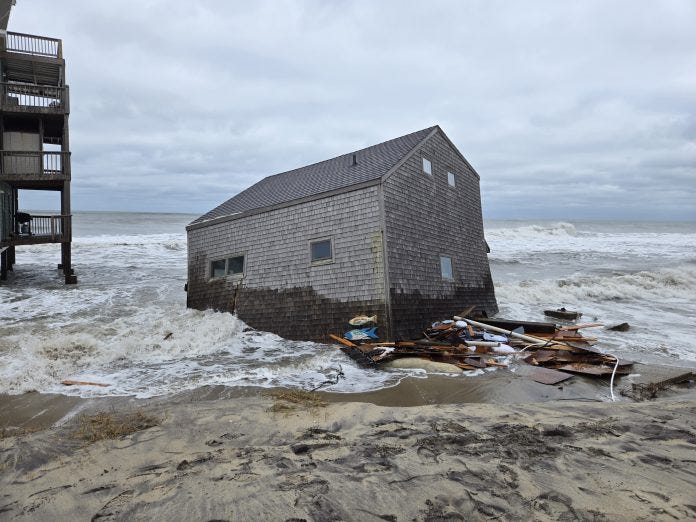
From Zillow.com, this was a pricey house:

This house could have stood for another few decades, but it collapsed into the ocean due to coastal erosion that was certainly made worse by sea level rise. When that happened, its value instantly dropped to zero, a stark, nonlinear impact that produced a stranded asset.
While physical risks can strand assets, the concept first gained prominence in discussions about transition risk and the fossil fuel industry. Oil and gas companies are valued in the trillions of dollars, with much of that valuation based on their proven reserves—oil and gas that is in the ground and ready to be produced. The transition to a net-zero economy, however, requires that a significant portion of these reserves be “left in the ground” and never burned. Once the market fully accepts that these assets cannot be produced due to climate policies, their value could drop to zero rapidly.
The danger of these fossil fuel assets becoming stranded extends far beyond the energy companies themselves. It poses a systemic risk to the broader economy because large swaths of the general public have financial exposure to these companies through their investments, including 401k programs, pensions, and mutual funds. The sudden devaluation of these energy assets could negatively affect many people’s investment and retirement funds, which in turn could have a widespread and devastating impact on the financial security of the general public.
This same principle applies to the real estate sector. Consider a commercial office building with a low energy efficiency rating located in a city that passes a new ordinance mandating high-performance standards for all buildings. The owner is suddenly faced with a difficult choice: either undertake a costly, large-scale retrofit to meet the new legal requirements or risk being unable to legally rent the space. If the retrofit is too expensive, the building’s value is stranded, as its primary function — generating rental income — has been eliminated by a policy change aimed at reducing emissions.
Another often-overlooked category of risk lies in intangible assets. For companies in the S&P 500, these assets — such as brand value, reputation, and intellectual property (IP) — can represent up to 90% of their total market value. Their non-physical nature makes them vulnerable to rapid devaluation. For example, imagine a company that holds a highly valuable portfolio of patents for a new, efficient diesel engine technology. If a major country or region, aiming to meet climate targets, decides to ban the sale of all new diesel cars, the market for that technology disappears. The intellectual property, once a significant asset, has its value evaporate almost overnight. This is a direct parallel to the risk facing fossil fuel companies, whose reserves — a tangible asset on paper — could become worthless if they cannot be produced.
A final critical category that is often overlooked is human capital. Human capital represents the skills, knowledge, and expertise that workers have developed over their careers — assets that can suddenly lose their value in the transition to a low-carbon economy.
Consider a mechanic who has spent 30 years perfecting the art of repairing internal combustion engines. This individual has accumulated expertise in diagnosing problems, understanding the mechanical systems, and maintaining gasoline-powered vehicles. As the world shifts to electric vehicles — which require fundamentally different maintenance skills — this expertise becomes obsolete. The mechanic’s human capital, built over decades, is stranded.
The scale of this challenge is enormous. Huge numbers of workers have built their careers in fossil fuel industries. Coal miners possess specialized knowledge about underground operations, safety protocols, and extraction techniques. Oil field workers understand drilling technologies, reservoir management, and petroleum systems. Pipeline operators and refinery technicians have invested years developing skills specific to a carbon-intensive economy. As these industries contract or disappear entirely, these workers face the prospect of their expertise becoming rapidly becoming worthless.
This creates both an economic and social crisis. Unlike a stranded power plant that can be written off a company’s books, stranded human capital represents real people with families, mortgages, and communities that depend on their income. A 50-year-old coal miner cannot simply retrain as a software developer overnight. The geographical concentration of these industries compounds the problem — entire regions have been built around fossil fuel extraction, creating communities where the primary source of skilled employment may disappear.
The human dimension of stranded assets also creates political risk for the climate transition itself. Workers facing the loss of their livelihoods can become powerful opponents of climate action, slowing the transition for everyone. The fear and anger generated by the transition can translate into political movements that resist or reverse climate policies, as workers vote to protect their immediate economic interests over longer-term economic reality.
The TCFD Framework: Four Key Drivers of Transition Risk
To better understand and manage transition risks, the Task Force on Climate-related Financial Disclosures (TCFD) developed a framework that organizes these risks into four distinct categories. This framework has become the global standard for how companies and investors think about and report climate-related financial risks.
1. Policy and Legal Risks
Policy and legal risks emerge when governments and courts take action to address climate change. These interventions can fundamentally alter the economic landscape, often with little warning.
Carbon pricing represents one of the most direct policy tools. When governments implement a carbon tax or cap-and-trade system, they make it more expensive to emit CO2. For instance, a carbon price of $50 per ton of carbon dioxide would add around $20 to the cost of a barrel of oil, fundamentally changing the economics of oil production and consumption. Companies that built their business models around cheap fossil fuels suddenly face dramatically higher operating costs.
Efficiency standards create another layer of policy risk. The UK’s Minimum Energy Efficiency Standard (MEES) provides a clear example: it prohibits landlords from renting properties with poor energy efficiency ratings. A landlord who owns an older, inefficient building faces a stark choice — invest heavily in retrofits or watch the property become unrentable, thereby creating a stranded asset.
The legal dimension adds another layer of risk through climate litigation. There are many lawsuits winding through the courts where people are taking fossil fuel companies to court because they have been or expect to be harmed by climate-change-driven extreme weather. This potential climate liability could expose fossil fuel companies to enormous financial risk, much like tobacco companies faced when the health impacts of their products became legally actionable.
2. Technology Risks
Technology risk represents the classic story of disruption — when a new, cheaper, or better technology makes existing technologies obsolete. In the climate context, this risk is accelerating as clean technologies have reached critical tipping points.
The most dramatic example is the drop in renewable energy costs. Solar power costs have fallen nearly 90% over the past 15 years. In most parts of the world, building a new solar or wind farm is now cheaper and faster than building a new coal or gas plant — even without subsidies. This is rapidly reordering energy economics and energy markets. Coal plants that were expected to operate profitably for 40 years are being shut down early not because of regulation, but because they simply can’t compete economically with cheaper energy sources. Natural gas plants will be next.
Electric vehicles present another technological disruption. As battery costs decline and performance improves, EVs are becoming not just environmentally preferable but superior products — they accelerate faster, require less maintenance, and increasingly cost less to own and operate than internal combustion engines. This technological shift threatens not just automakers who are slow to adapt, but entire ecosystems built around gasoline vehicles: gas stations, oil change shops, parts suppliers, and even dealerships whose business models depend heavily on service revenue from complex internal combustion engines.
3. Market Risks
Market risks encompass the shifts in supply, demand, and investor sentiment that can rapidly revalue assets and companies.
As an example, demand for transition minerals like lithium, cobalt, and copper is soaring as the world builds batteries and renewable energy infrastructure. Companies that secured supply chains for these materials early have gained significant competitive advantages, while those arriving late face production bottlenecks and inflated costs. Conversely, demand for thermal coal is collapsing in many regions, leaving coal mining companies with reserves that may never be extracted.
Perhaps more significant is the shift in investor perceptions. For decades, oil companies were valued based on their proven reserves — the oil and gas they had rights to extract. Now, many investors view these same reserves as worthless, unburnable carbon that will never generate revenue. This shift in perception led BP to write down its assets by $17.5 billion in 2020, with Shell following with a $22 billion write down. These companies acknowledged that much of their oil would likely remain in the ground forever.
The power of changing investor sentiment was dramatically demonstrated in 2021 when Engine No. 1, a tiny activist hedge fund, successfully won three board seats at ExxonMobil. Their argument wasn’t environmental but purely financial: Exxon’s failure to plan for the energy transition was destroying long-term shareholder value. This showed that transition risk has moved from the margins to the center of corporate governance.
4. Reputational Risks
Reputational risk reflects the changing expectations of consumers, employees, and society at large. As public concern about climate change grows, companies associated with high emissions face damage to their brands and their social license to operate.
The financial sector illustrates how reputational concerns translate into business decisions. In 2019, Goldman Sachs announced it would no longer finance new thermal coal mines or Arctic oil exploration. While framed partly in risk management terms, the bank explicitly cited reputational considerations and changing client expectations as key drivers. They recognized that being associated with these projects was becoming bad for business, potentially costing them clients and talented employees who increasingly consider environmental factors in their career choices.
Consumer pressure is also reshaping entire industries. The rapid growth of plant-based milk alternatives like Oatly directly responds to, among other things, consumer concerns about dairy’s environmental impact. Traditional dairy companies, seeing their market share erode, are scrambling to launch their own non-dairy alternatives. This shift isn’t driven by regulation or technology costs but by changing consumer preferences that make high-emission products less desirable, regardless of price or quality.
5. Putting it together
These four categories of risk — policy and legal, technology, market, and reputation — don’t operate in isolation. They interact and amplify each other, creating feedback loops that can accelerate the transition and magnify risks for unprepared economies.
Consider how technological advances in renewable energy trigger cascading effects across all risk categories. As solar and wind become cheaper than fossil fuels (technology risk), governments gain political cover to implement stricter emissions standards and carbon pricing (policy risk), knowing these policies won’t dramatically increase energy costs for voters. These policies, in turn, shift investor capital away from fossil fuels and toward renewables (market risk), further driving down clean energy costs through economies of scale. Companies slow to adapt find themselves not just technologically obsolete but facing reputational damage for clinging to outdated, polluting technologies (reputational risk), which makes it even harder to attract capital, customers, and talent.
The automotive industry provides another vivid example of these interconnected risks. As electric vehicles improve and battery costs fall (technology risk), governments implement EV mandates and phase out internal combustion engines — Norway by 2025, the UK by 2030 (policy risk). These policies signal to investors that traditional automakers without credible EV strategies are poor long-term investments, triggering capital flight (market risk). Meanwhile, young consumers increasingly view gas-powered vehicles as environmentally irresponsible, especially luxury gas vehicles (reputational risk). Each risk reinforces the others: technological improvements justify stricter policies, which shift market dynamics, which shape public perception, which in turn creates pressure for even more aggressive policies and faster technological development.
Understanding these interconnections is essential for understanding transition risk. A company cannot address one type of transition risk while ignoring the others — they must recognize that these risks compound and prepare for the systemic changes that result from their interaction.
The “Just Transition”
The recognition that the shift to a low-carbon economy will create winners and losers, particularly among workers and communities reliant on fossil fuel industries, has given rise to the concept of a just transition. A just transition is an effort to ensure that the benefits of a green economy are shared broadly and that the costs do not fall unfairly on those who can least afford them.
The core idea is to provide support, retraining, and new economic opportunities for workers and communities whose livelihoods are threatened by the phase-out of carbon-intensive industries. This is not merely an ethical consideration; it is a pragmatic one. The threat of widespread job losses can create powerful political opposition to climate action, potentially slowing down or even derailing the transition for everyone. Therefore, managing the human side of the transition is critical to its success.
In a just transition, we would repurpose skills: For example, the skills required to build an offshore oil rig are similar to those needed for constructing an offshore wind platform. A just transition would facilitate this shift through targeted programs.
The private market is unlikely to manage this process efficiently or equitably. Government action is therefore needed to fund retraining programs and help workers seamlessly switch to new jobs in the growing green economy.
Germany’s approach to phasing out coal mining in its Lausitz region serves as a prominent example. The German government is investing €40 billion to manage the process by funding new infrastructure, research institutes, and extensive retraining programs. The goal is not just to compensate for lost jobs but to actively build a new, sustainable economic future for the region.
Conclusion
Transition risk represents a fundamental restructuring of the global financial and social order. As this chapter has detailed, the journey toward a net-zero economy is far more than a simple technological swap. It is a complex, multi-dimensional shift driven by the interplay of policy, technology, and market and social dynamics. While this transition offers immense opportunities for innovation and growth in green sectors, it simultaneously creates the systemic threat of stranded assets — devaluing not just physical infrastructure and fossil fuel reserves, but also intangible intellectual property and the human capital of millions of workers.
Ultimately, the success of this overhaul hinges on the ability to manage these risks. Because the private market is not naturally equipped to solve the social dislocations caused by such rapid change, proactive governance and strategic investment are essential to ensure a just transition, so that the shift to sustainability does not leave vulnerable communities behind. Balancing the urgent need for decarbonization with the economic security of the workforce is not just a moral imperative, but a practical necessity to maintain the political and social stability required to reach our climate goals.
This is a draft of a section of my climate risk textbook (slightly edited & reformatted to make it appropriate for Substack). I’d very much like to identify errors now, so if you see any, please let me know in the comments.
I’d be grateful if you could hit the like button ❤️ below! It helps more people discover these ideas and lets me know what’s connecting with readers.
Amazing! But this line may not age well since software developers may be gone before coal miners: "A 50-year-old coal miner cannot simply retrain as a software developer overnight."
If I were not already committed to the necessity of fundamental change in our culture, I might
be frightened away by this. My first impression is that there's no way this can be even planned, let alone implemented without strong governance and leadership in all sectors both nationally and internationally. This should be required reading for all students. I shall flag it for my grandkids. Thank you for this enormous effort.