

AI energy use is a huge and controversial topic at the moment. Credible estimates have AI data centers accounting for around 12% US electricity use by 2030. But at the same time consumers have been given reassuringly small numbers about the impact of their own AI use, numbers that seem on their face somewhat inconsistent with the staggering size of their aggregate usage.
In 2025 Google published an article calculating that median Gemini text prompt used only 0.24 watt-hours (Wh), less energy than “watching nine seconds of television”. Around the same time, Sam Altman said that an average ChatGPT query uses about 0.34 Wh, and Epoch AI came out with similar numbers. Writers like Andy Masley and Hannah Ritchie have shown that at these rates an individual using chatbots has a pretty negligible impact, with one prompt only amounting to roughly 1/150,000th of an average American’s daily emissions.
Those numbers are basically right. They are also increasingly divorced from how AI is actually being used today.
The fastest-growing way that software engineers and scientists actually use AI is not typing questions into a chat box. Rather, we use AI agents through tools like Claude Code and Codex that plan, write code, run it, read the results, and iterate on their own. These agents make dozens of model calls per human prompt, and engage in complex reasoning chains that involve attempting and evaluating multiple answers to the same question.
I work for a company in Silicon Valley (Stripe) and admittedly use the latest AI tools more than most people. But I thought it would be instructive to take a deep dive into my own AI use over the past 8 weeks and calculate the actual energy use I was responsible for.
Over the past 8 weeks I typed 1,138 prompts into Claude Code. Those prompts triggered more than 14,000 model calls that processed 3.2 billion tokens. My best estimate is that this used around 170 kWh of data center electricity (with an uncertainty range of roughly 70 to 330 kWh across methods and assumptions). That works out to around 150 Wh per prompt (60 to 290 Wh), which is roughly 600 times (250 to 1,200) the energy of a median chat prompt. A “prompt” is ultimately not a unit of AI use any more than “trips” is a measurement of driving; it’s how far you go that matters.
Agents supercharge AI usage
Part of the impetus for this post is the publication of a new white paper from Watershed (Bistline et al. 2026) proposing a standardized framework for corporate AI emissions accounting. It is the most careful treatment I have seen of why published per-query numbers differ by orders of magnitude (system boundaries, mostly), and it contains a figure that should reframe the whole discussion: electricity per AI task spans more than five orders of magnitude, from thousandths of a watt-hour for text classification to 50-500 Wh for an agentic workflow making 5-50 frontier model calls. As they put it, emissions attributed to one “interaction” may understate the compute actually consumed “by an order of magnitude or more.”
Other researchers have found similar results. Bai et al. (2026) measured coding agents on real software tasks and found they consume roughly 1,000 times the tokens of an ordinary chatbot interaction. And these sort of agents tasks represent the most rapid driver of increased AI usage; Anthropic’s Economic Index found that 97% of their API usage now show “automation-dominant” patterns associated with agents.
To put these values in perspective, the figure below compares published per-prompt and task estimates (blue) with what I measured from my Claude Code use (orange) as well as common benchmarks for energy use (running a microwave, a fridge, or a whole home):
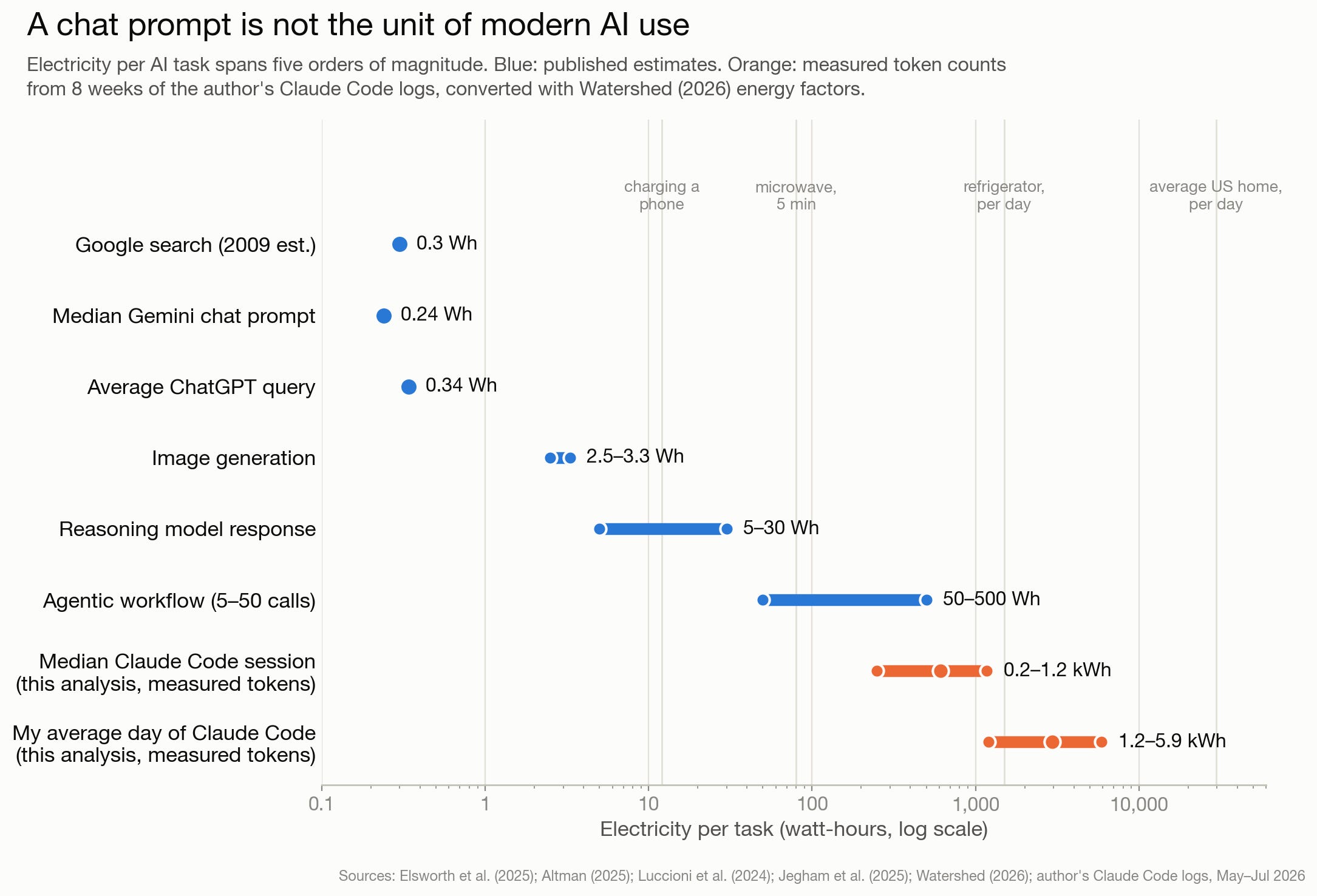
My median Claude Code session uses around 0.6 kWh (0.25 to 1.2 kWh), which is at the top end of Watershed’s generic agentic usage estimate, and fifty times the energy used to charge a cellphone. My average day of Claude Code (3.0 kWh, range 1.2 to 5.9 kWh) uses more electricity than running two refrigerators.
Measuring my own footprint
Claude Code keeps complete local transcripts of every session, including the exact token counts the API reports for every model call.1 This lets me precisely know how much AI usage I was responsible for rather than simply extrapolating it from published benchmarks; its only the step to convert tokens used to energy that requires assumptions.
The first thing I found is that the gap between “prompts” and reality is massive: my 1,138 typed prompts resulted in just over 14,000 distinct model calls (12 per prompt), and each prompt consumed on average 2.9 million tokens. For comparison, typical web-based AI chat exchanges with no reasoning or web searches only use around a thousand tokens.
Over the past the 8 weeks, my Claude Code used 3.2 billion tokens. These overwhelmingly came from the agent re-reading its own working memory. Every time an agent takes a step (e.g. runs a command, reads a file, or calls a tool), the model re-processes its entire accumulated context. The figure below shows the breakdown of how tokens were used and their share of total electricity use.
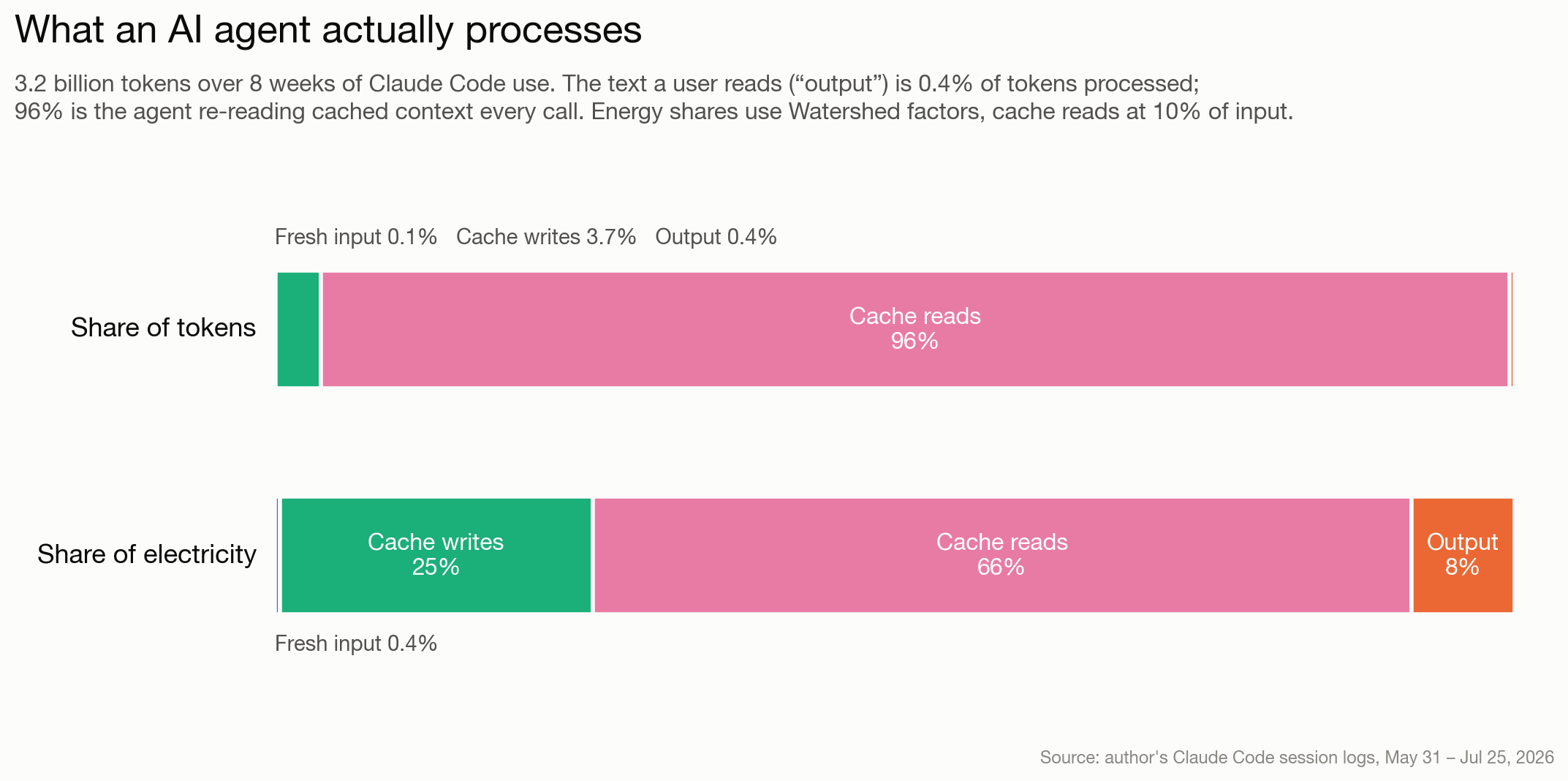
The text I actually see (e.g. the model’s output) is only around 0.4% of total tokens processed. Some 96% of the tokens are cache reads where the agent re-reads its own context at each of those 14,000 steps. This matters enormously for the energy estimate, because a cached token is much cheaper to re-read than a fresh one is to process. AI companies charge about 10% of the price for cache reads compared with fresh content, and I use that ratio as my central energy assumption, with 1% and 25% as bounds.2
Since nobody outside of the labs actually knows the true per-token energy of a frontier model (Anthropic has published no per-prompt or per-token figures, something the Watershed paper politely but firmly flags as the field’s biggest data gap), I ran my measured token counts through three independent published methodologies: Watershed’s activity-tier factors, the per-token factors Simon Couch’s estimates derived from Epoch AI’s work, and the claude-carbon tool’s pricing-inferred coefficients.
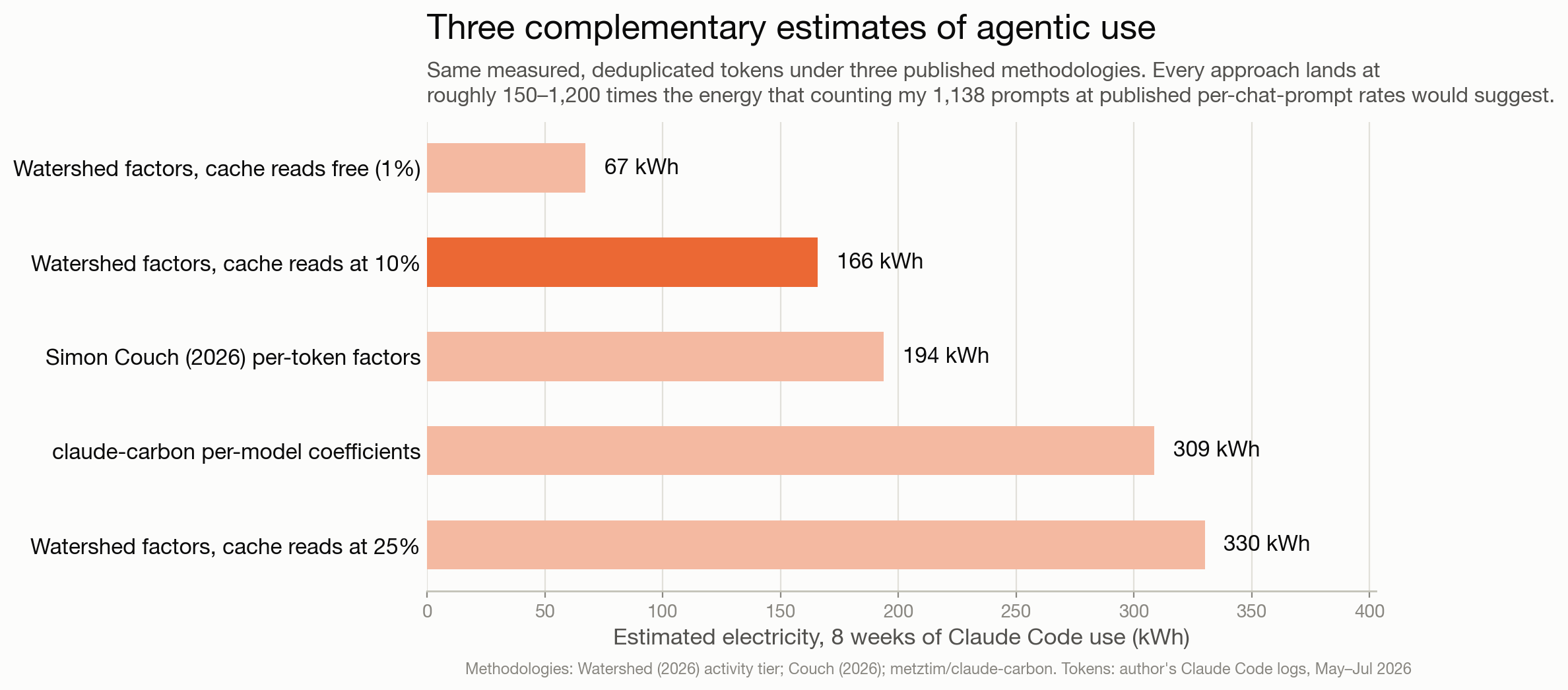
Every one of these methodologies gives an answer between roughly 70 and 330 kilowatt-hours over 8 weeks. The estimate is genuinely uncertain, by a factor of ~2 in either direction. But the broader conclusion is not: counting my 1,138 prompts at published per-chat-prompt rates would have suggested about 0.3 kWh, while the reality is 150 to 1,200 times that.
My daily pattern of energy use is shown in the figure below. The day to day variability is huge: my heaviest day (11 kWh central estimate) involved multiple parallel agents churning through a large geospatial analysis, and used more than a third of the total daily electricity of an average US home. This reflects that fact that even within the category of agentic usage, the complexity of the task and the number of simultaneous sub-agents used will greatly influence the resulting energy use.
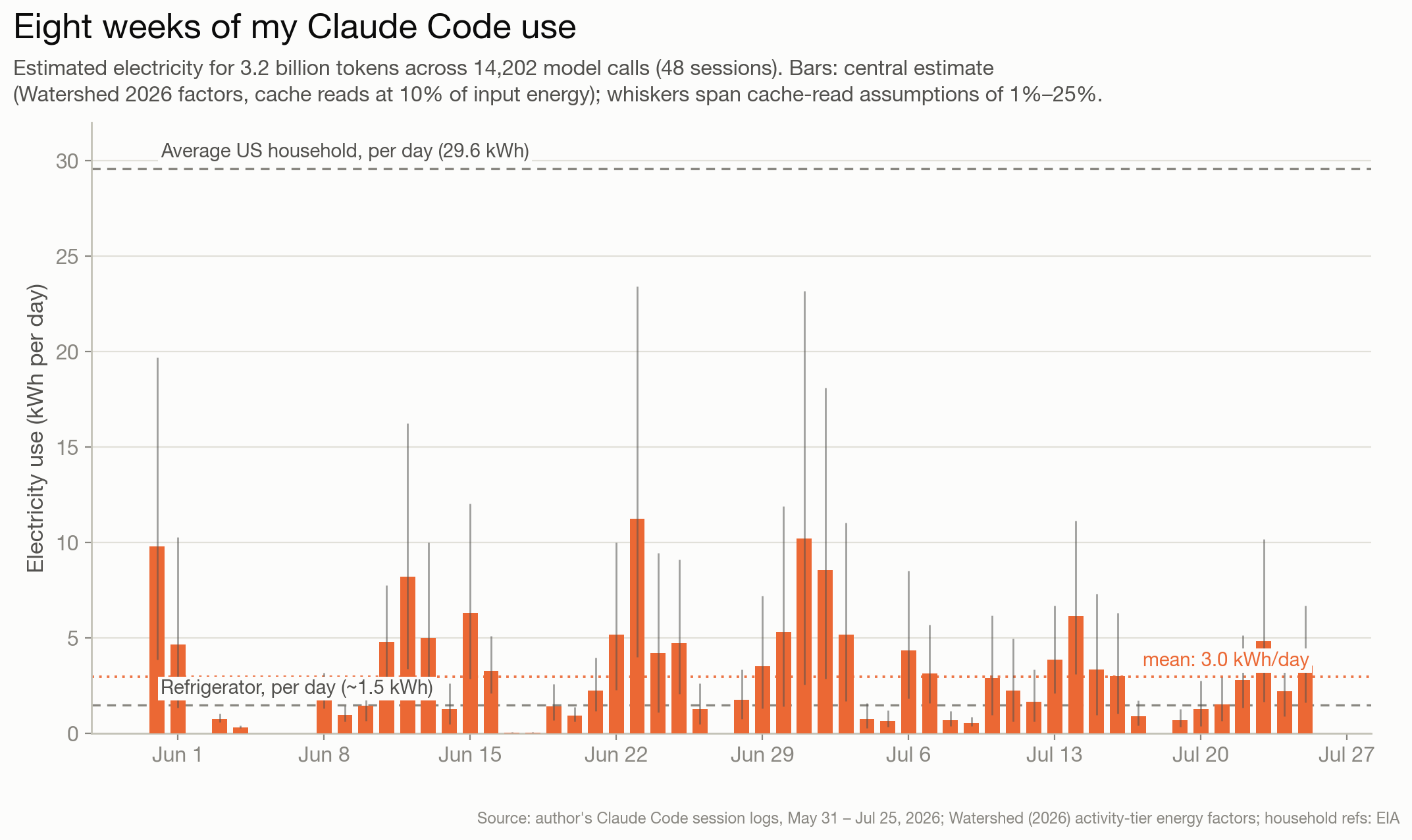
My numbers are a bit higher than some of the other published estimates of agentic use, and it is worth digging in a bit to determine why. Couch estimated that a median Claude Code session uses around 41 Wh, involving 24 model calls and 592k tokens. Andy Masley’s June 2026 calculator puts a 100k-token Claude Opus agent session at ~459 Wh. My median session is ~600 Wh, involving a hundred-plus calls and around ten million tokens including numerous subagents for large data analyses projects. Hannah Ritchie’s hypothetical heavy user (24 agentic queries a day) came out at 2.4 kWh/day, while I measured a central estimate of 3.0 kWh/day (1.2 to 5.9 kWh) for my actual usage.
None of these estimates are necessarily wrong, they just reflect a wide range of actual usage assumptions. Software engineers, researchers, and data analysts (e.g. folks like me) probably lie pretty far down the tail of the usage distribution. At the same time, usage will likely grow over time as more complex agentic tools increasingly become the norm.
What a year of this looks like
If we assume that these 8 weeks are fairly typical, we can estimate that a full year of my agentic Claude Code use would consume roughly 1.1 MWh of data center electricity (0.4 to 2.2 MWh), which is about a tenth of what an average US household uses. Applying the US-average grid intensity, that is roughly 370 kgCO2e per year (150 to 730 kgCO2e).3
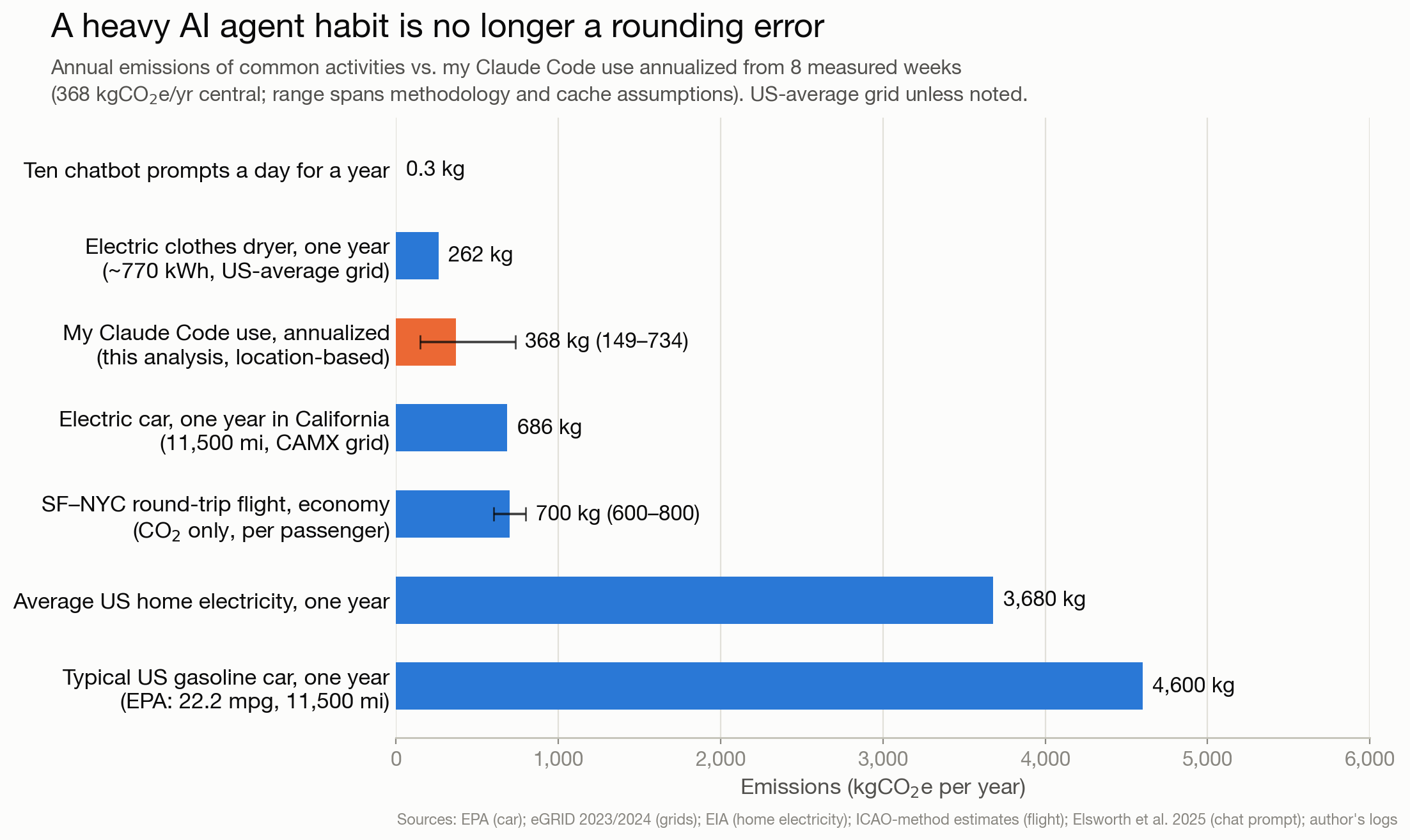
My personal and professional AI usage now emits a bit more per year than running an electric clothes dryer, and about half as much as driving an electric car 11,500 miles in California or taking one San Francisco to New York round-trip flight in economy.4 It is about 8% of the annual emissions of a typical American gasoline car, and roughly 2% of the average American’s ~18-ton annual greenhouse gas footprint.
This is simultaneously a large emissions source and a relatively modest part of my total carbon footprint. I typically take a round trip flight from San Francisco to the East Coast twice a year to visit my aging parents (not to mention work travel), and I generally don’t lose sleep over that choice. It is also fundamentally a much easier-to-decarbonize end-use than aviation (more on that below). But this also represents a net new source of emissions, at a time when global temperatures are skyrocketing and our emissions reduction goals are increasingly off track.
So what do we do about it?
Having spent most of this post arguing that agentic AI use is hundreds of times more energy intensive than the chatbot numbers suggest, let me be clear that I don’t think the answer is guilt or abstinence. But there are real levers here that we can use to shape the trajectory of AI energy use and emissions going forward.
On the personal side we can try and not be frivolous with agentic tools. There is a real difference between pointing five parallel agents at a hard research problem and doing the same to settle a bar bet (or, in my case, making axolotl-themed games with my daughter). What models you use matters too: sending simple tasks to smaller models uses perhaps 5 to 7 times less energy per token than defaulting to a frontier model,5 and it is what I increasingly do for searches and mechanical work. That said, I don’t want to oversell this. My entire annual AI footprint is a few hundred kilograms of CO2; personal restraint by the small population of heavy users is not going to bend any curves.
The technology lever is more powerful, and it is genuinely impressive. The figure below shows the energy efficiency of NVIDIA’s data center chips over the past decade. The amount of math an AI chip can do per joule of energy has grown roughly 150-fold since 2016, doubling about every two years, per Epoch AI. The latest B300 chips running at their lowest supported precision use about a quarter of the energy per operation of the 2022-era H100s that trained today’s frontier models. This represents a 3.8-fold improvement in energy efficiency in three years. Software gains can make this even faster: Google reports the energy of a median Gemini prompt fell 33-fold in a single year through a combination of better models, better tools, and better hardware.
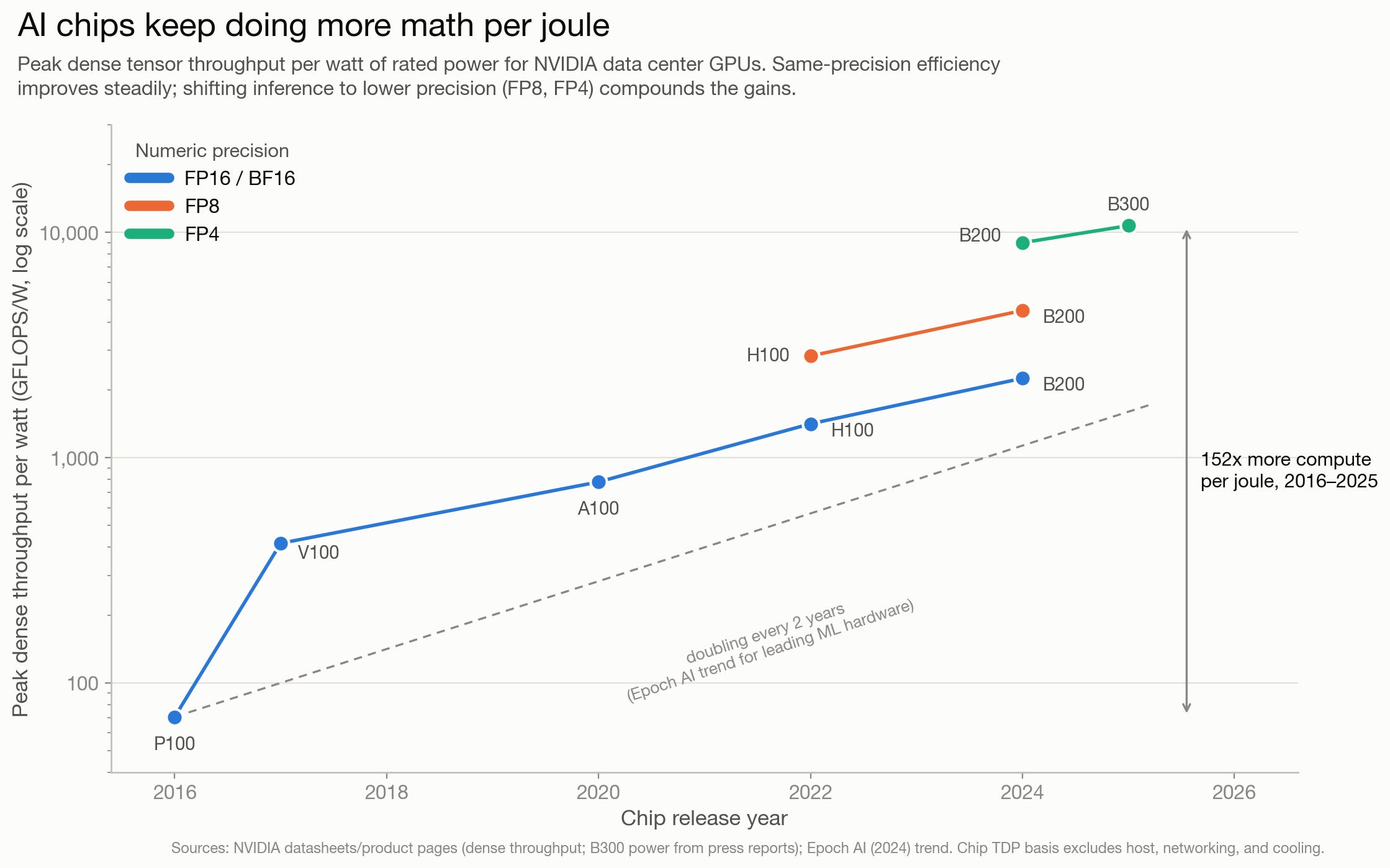
But if 150-fold efficiency gains were going to reduce AI’s energy use, they would have done it by now. This is the Jevons paradox in action: making compute cheaper per token in turn tends to lead to greater levels of AI use. Efficiency is why my agentic habit costs 170 kWh rather than the 950 kWh it would have used with 2020-era hardware. But efficiency only determines how much intelligence we get per unit of energy, but so far it has so far shown no sign of determining AI’s total energy use.
Which is why the lever that actually matters most is the carbon intensity of the electricity. Every number in this post assumed the US-average grid; run the same workload on largely clean power and my footprint falls by roughly 90%. Unlike aviation, this is an end-use we already know how to decarbonize.
The problem is that we are moving in the wrong direction today: a sizable portion of planned US data center capacity intends to build its own behind-the-meter generation, and nearly three quarters of that is natural gas. AI companies with genuine climate commitments need to do better at finding alternatives: solar plus storage (which I helped lead a study about in 2024), next-generation nuclear and restarts of retired reactors, enhanced geothermal, and siting data centers in regions where both the average and the marginal generation is low-carbon).
There is also a silver linings version of this story where AI demand becomes an asset for decarbonization. Getting to net-zero emissions requires roughly tripling electricity generation by mid-century as we replace nearly all the current uses of fossil fuels with clean electricity. The barriers are mostly not technological, but rather things like interconnection queues, permitting, transmission. The AI buildout is a preview of that world of rapidly increasing electricity demand, backed by companies with enormous capital and unusual urgency. If that money and impatience gets spent speed-running the elimination of those barriers (buying firm clean power, funding transmission, absorbing the early costs of advanced nuclear and geothermal the way early corporate buyers did for wind and solar), the AI boom could leave the grid cleaner than it found it. If it gets spent on behind-the-meter gas turbines, it won’t. That choice is being made right now, and it will matter far more than how many prompts any of us type.
In the interest of full disclosure: the python code underlying the analysis and figures in this post were, naturally, built with the help of Claude Code, but the writing is all mine.6
Claude Code records API usage including the amount of uncached input tokens, cache-creation tokens, cache-read tokens, and output tokens, per model call, with model IDs and timestamps. One logging subtlety matters a lot: each API response is written to the log as one line per content block, with every line repeating the message’s full usage object, so a naive line-by-line sum double-counts tokens by a factor of ~2.2. All numbers here count each API message once, deduplicated by message ID.
A cache read retrieves already-computed attention states from memory rather than recomputing them, so it is much cheaper than inputting fresh data, but its not free. Cache reads context still makes each output token more expensive to generate at long context. Anthropic prices cache reads at 10% of fresh input, and the claude-carbon and Couch methodologies both adopt ~10% as an energy ratio. Watershed flags cache handling as a known gap in per-token accounting; my 1%-25% band is intended to span the plausible range.
Using the eGRID 2024 US-average 341 gCO2e/kWh, since Anthropic does not disclose where their data centers are located and what electricity sources they use. Market-based emissions (counting providers’ clean power purchases) would probably be lower, potentially much lower. This estimate excludes my laptop, which at ~50 W is negligible against 3.0 kWh/day of data center load.
Note that the flight estimate here only includes direct CO2 emissions from aviation; including contrails and other secondary factors would probably increase flight emissions by at least 50%.
Based on inferring energy use through token pricing, claude-carbon gives ~0.3 J/token for Haiku-class vs ~2 J/token for Opus-class models.
In a good example of why you always need to double check work done with AI coding tools, Claude accidentally doubled its original estimate of my token use as all the relevant files were stored twice and it simply added them all up. I only caught it because the numbers seemed too high!
This is exactly the direction the conversation needs to go. We've spent a lot of time debating the energy cost of a single prompt, but agentic AI changes the unit of analysis. The better question may be: what outcome did that energy produce? Looking at prompts in isolation risks missing the much bigger systems story. Thanks for a thoughtful piece.
I was surprised by this quote:
"The amount of math an AI chip can do per joule of energy has grown roughly 150-fold since 2016, doubling about every two years, per Epoch AI."
I checked your chart and it looks like you're comparing the P100 with FP32 computation to the B300 with FP4 precision. The precision makes a huge difference! It's more computation with higher precision. So a more apples-to-apples comparison would use the same precision level, which would lead to a much lower but still big increase in efficiency from computer hardware. Epoch AI estimates 1.4x efficiency per year, https://epoch.ai/data-insights/ml-hardware-energy-efficiency, so over a decade that is about 30x more efficient.
The less precise computation like FP4 and software improvements can really help with efficiency too as you point out. I really like that you raised the Jevon's paradox. I agree that all the efficiency together is driving more usage.