

There’s been a lot of discussion recently of wildfires and their relationship to climate change. Here at TCB, we’ve written a lot about the connection between climate change and wildfires.
To be clear: Climate change is absolutely making these wildfires more severe — there should be zero doubt about that.
Thankfully, most of you will never come face-to-face with one of these massive, climate-enhanced beasts. But a lot of you will breathe the smoke they produce.
In some respects, this is worse than the fires themselves: wildfire smoke kills 24,000 Americans per year. And it negatively impacts our lives: it forces people to stay indoors, ruins vacations, drives people to spend money on air purifiers, destroys ice cream bars, and so on.
I was wondering if we could see a trend in wildfire smoke, so I decided to look at the data.
Smoke data
I downloaded wildfire aerosol data from NASA1 and plotted how smoke frequency has changed over the past two decades across the continental U.S. (CONUS):
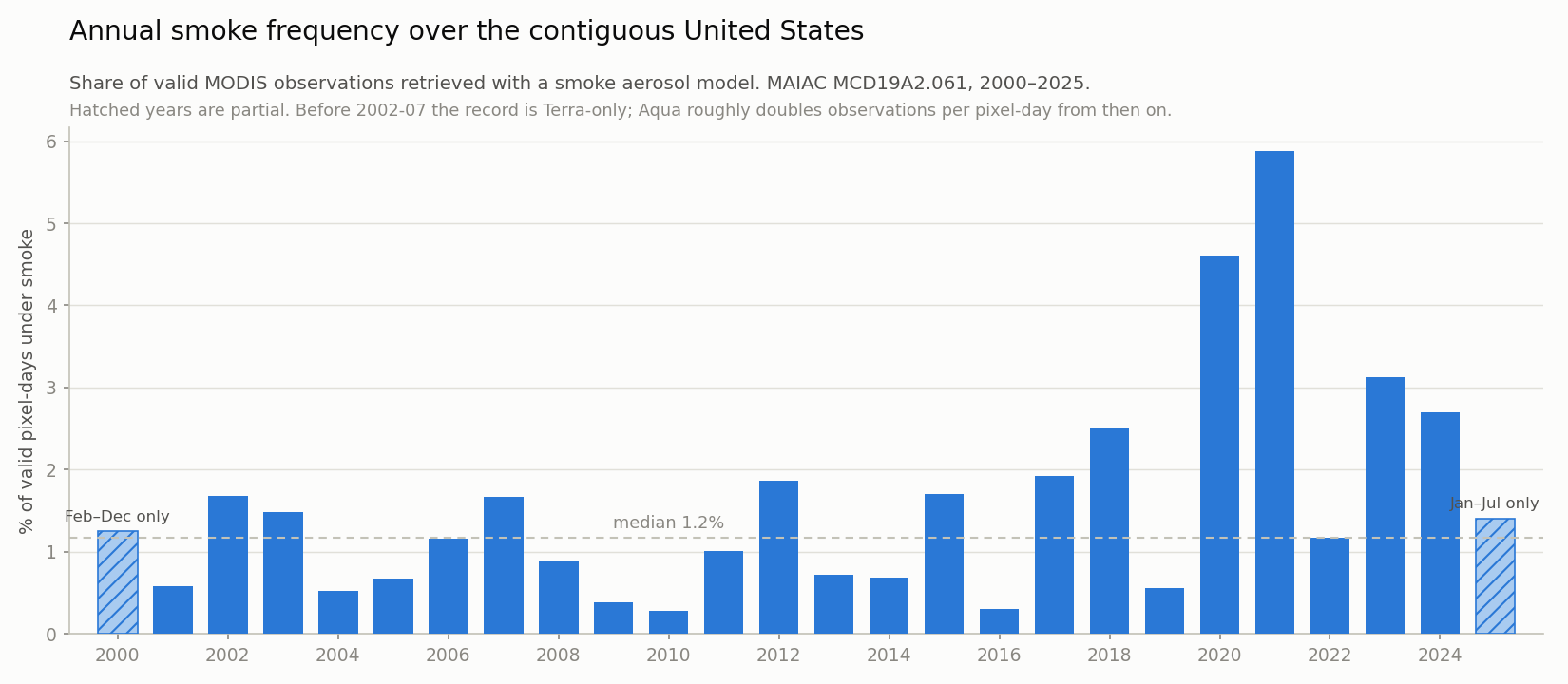
As you can see, starting around 2018, smoke over the U.S. has gotten worse (positive trend is statistically significant). Before 2018, no year averaged more than 2%, while five of the next seven (complete) years did.
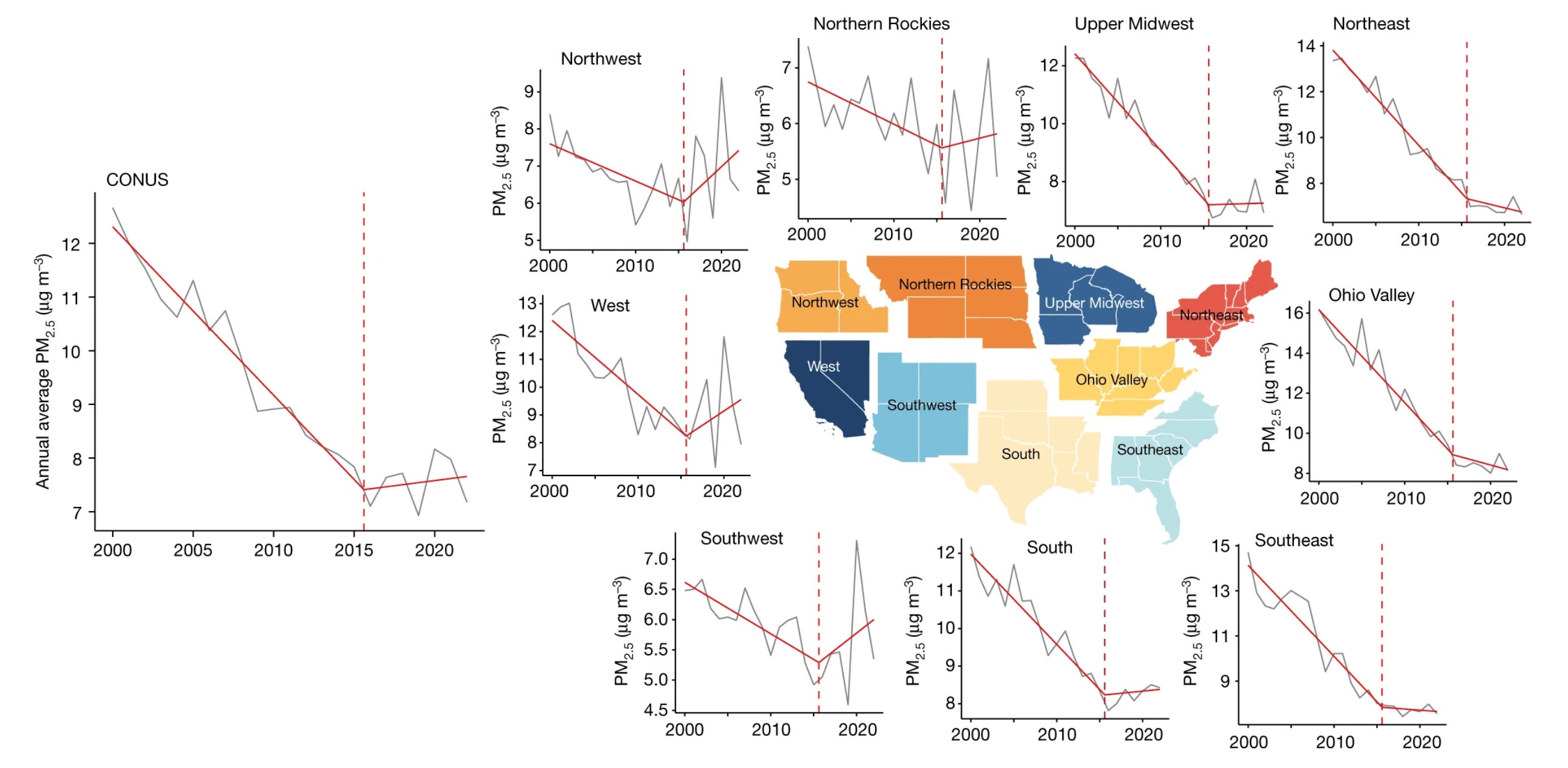
This is consistent with research that showed that U.S. air quality, which had been improving for decades, started getting worse around 2016 due to wildfire smoke.
Here are maps of the NASA smoke frequency over the past 25 years:
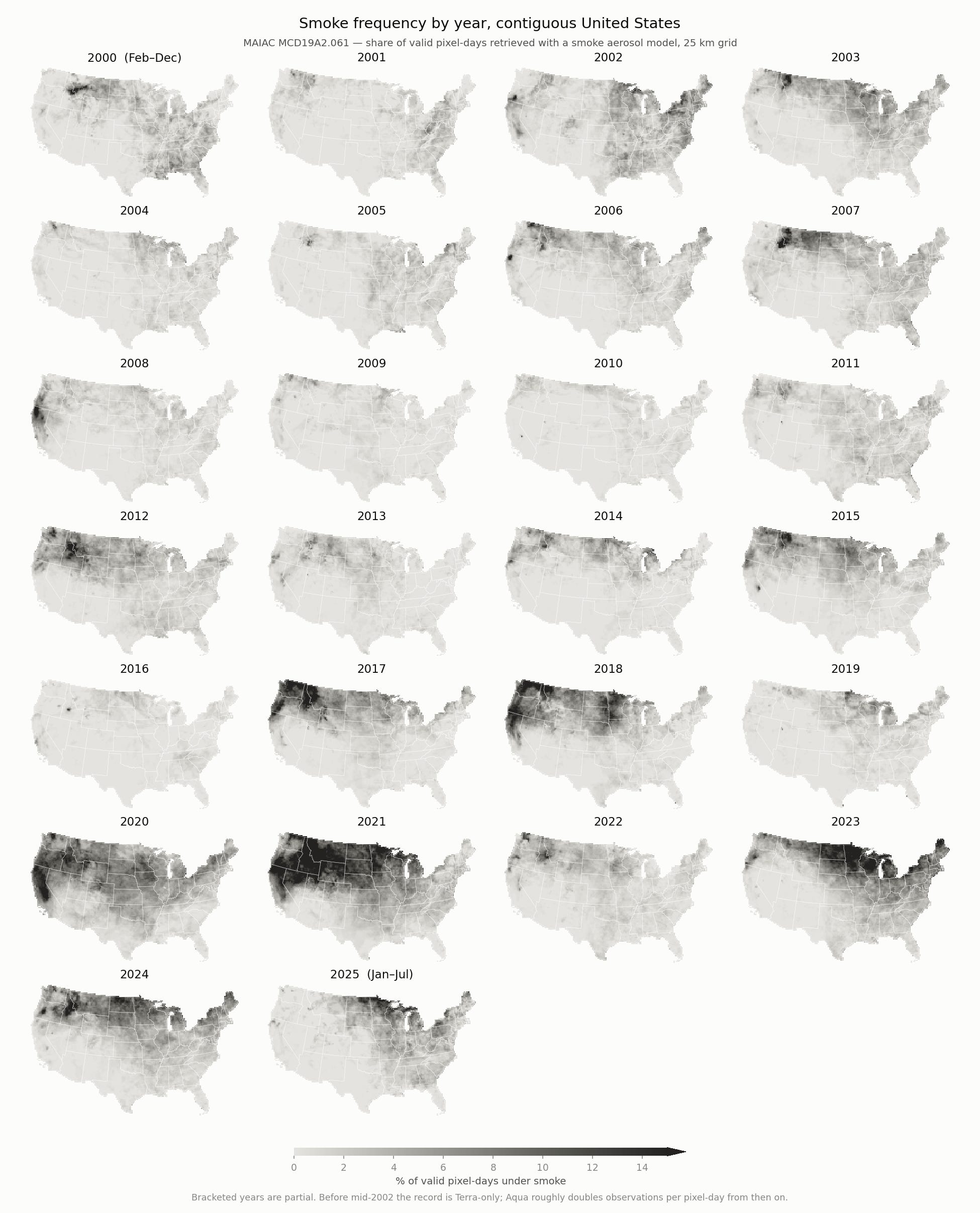
The “eye test” confirms that something changed in the late 2010s.
We can also make a difference plot showing the distribution of the increase in days per year covered by smoke:
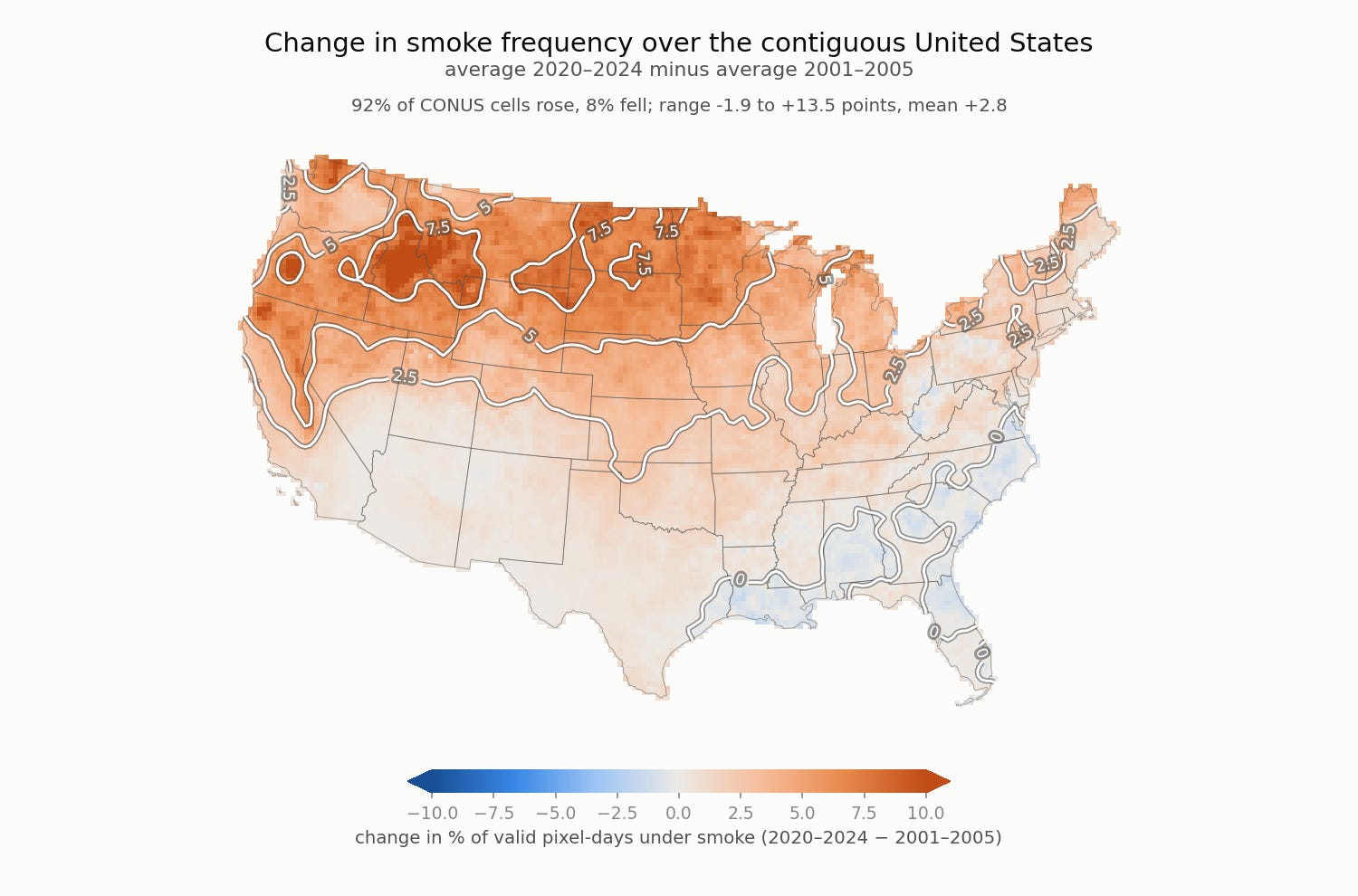
The data show that smoke occurrence increased over most of the U.S., with the upper west quadrant of the U.S. dominating the overall increase. In that region, there were 5-10 more days of smoke per year in the last few years than in the early 2000s.
Why is this worrisome?
Beyond the obvious — smoke kills people! — wildfire smoke shows how climate change is changing how we live. Robinson Meyer described this well in Heatmap News:
[S]tate and local governments across the eastern U.S. will now need to reckon with a new form of extreme weather. You grew up with snow days, but now we’ll have smoke days — and schools and sports leagues and concert venues will need rules about how to deal with them. When should games be canceled, tickets refunded? … Hotels and office buildings will need to review their ventilation policies and possibly upgrade their equipment; municipal emergency response plans will be revised and printed in triplicate.
But I think there’s an even bigger lesson here. Ten years ago, virtually no one talked about wildfire smoke as a serious climate impact. According to climate economists I surveyed on Bluesky, it is not really included in economic damage estimates of climate change. It turns out to be pretty costly, as Meyer described:
How costly? “When monetized,” a group of Stanford and Princeton economists wrote in Nature last year, in the first major study on the topic, “the climate-driven smoke deaths result in economic damages that exceed existing estimates of climate-driven damages from all other causes combined in the U.S.A.”
You read that right: The cost of climate-worsened wildfire smoke alone is larger than what earlier studies said every other estimated cost of climate change would be, combined.
Thus, we have suddenly — in just the last few years — come to understand that it is, in fact, a huge problem that we’re going to have to face as the climate warms. Daniel Swain said it well:
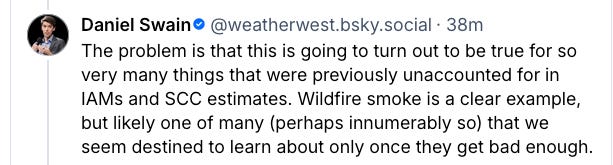
So, while we should definitely worry about wildfire smoke, we should also worry about other surprise catastrophes that are lurking and which we’ll only learn about after they occur. This should turbocharge our resolve to reduce emissions of greenhouse gases.
Appendix: the fire-denial machine
Because I’m sure someone will bring it up, let me address the “but acreage burned/number of fires has gone down” argument by quoting something I wrote in a previous post:
The argument that fewer acres burn today than burned in the early 20th century may be correct (the data are not great, so take that statistic with a grain of salt), but it’s also true that fires today are different from those in the early 20th century.
In the early 20th century, fires were typically of low intensity, easier to manage and extinguish, primarily consuming underbrush while leaving larger trees unharmed. In fact, fire played a crucial role in forest ecology, aiding in the natural cycle of regeneration and maintenance of healthy woodlands.
Today, the fires are absolute monsters. They can’t be stopped by humans. If they roll through your town, all they leave are foundations and chimneys and melted cars.
Fire seasons are longer (and sometimes they simply don’t end) and fires are occurring in places that they just didn’t occur in the past, like the Arctic.
How do we know all this? We can actually measure fires from space. For example, we can see that the heat put out by extreme wildfires has significantly increased over the last few decades:
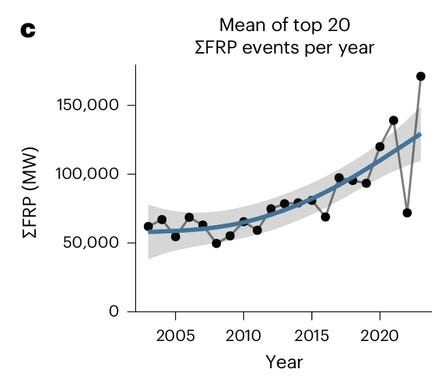
As you can see, the biggest fires of today are burning much hotter than just 20 years ago.
Thus, it doesn’t matter if more acreage burned in the 1930s if those fires were weak (e.g., grassland) fires that were easily extinguished. Today’s wildfires are just built different.
[update: TCB superfan “Gary” recommends people look at the EPA website AirNow, which shows you the current air quality in your area, or anywhere else in the U.S.]
Code to reproduce the NASA figures is here.
related stuff
People don’t appreciate how terrible air pollution is. It is truly one of the most underappreciated negative impacts of our fossil fuel addiction. For more on this, read David Wallace-Wells’ tour de force “Ten Million a Year”, which documents how air pollution kills, you guessed it, 10 million people per year.
I’d be grateful if you could hit the like button ❤️ below! It helps more people discover these ideas and lets me know what’s connecting with readers.
I’m analyzing the MODIS Multi-Angle Implementation of Atmospheric Correction product (MCD19A2). This product provides aerosol optical depth (AOD) at 470 and 550 nm, along with quality flags and information about which aerosol model was used for each retrieval. For this analysis, I identified pixels where the “smoke” model was used. Note that when MAIAC identifies a pixel as smoke, the reported AOD is the total column AOD; MAIAC is selecting a smoke aerosol model to perform the retrieval, not physically separating smoke from other aerosol sources. Thus, “smoke AOD” should be interpreted as AOD measured under conditions that the algorithm classified as smoke, rather than a direct measurement of the optical depth contributed by smoke alone.
Wildfires in Canada have burned to create large smoke plumes for long periods of time because they are hard to reach. We must anticipate worse events of similar type from the boreal forests of Siberia....
The impact of wildfire smoke needs much more attention as a communication topic to stir up popular interest in climate adaptation investments.
Excellent Highly recommended to read