

In a recent post on his Substack, Jim Hansen wrote about “runaway climates” on Earth, and I thought it would be useful to explain the physics of what this actually means and whether it’s something we need to worry about.
A runaway greenhouse occurs when humans add enough carbon dioxide to the atmosphere to push it past a threshold beyond which warming becomes self-sustaining and unstoppable1.
Venus is the canonical example of what that looks like. At some point in the past, it probably looked a lot like Earth. But then the planet heated up and boiled the oceans. Over time, ultraviolet radiation from the Sun split the water molecules into constituent hydrogen and oxygen atoms and the hydrogen escaped to space. In this way, the planet lost its water.
The loss of the ocean also caused the carbon cycle to shut down. This means that, unlike on Earth, where carbon dioxide is continuously removed from the atmosphere by dissolving into the ocean, there’s nothing removing carbon dioxide from the Venusian atmosphere. As a result, carbon dioxide accumulated in the atmosphere.
Today, Venus has an atmosphere that’s 90 times more massive than the Earth’s and it’s almost entirely carbon dioxide. The resulting greenhouse effect leads to surface temperatures around 450°C (850°F) — basically the temperature of your oven on self-clean cycle — and under pressures comparable to those at the bottom of the ocean.
In this hellish environment, spacecraft engineered specifically to survive Venusian conditions are still only able to last one or two hours before they are destroyed by the harsh environment.
So let’s take a step back and consider what it takes for the climate to run away.
what determines how much warming you get?
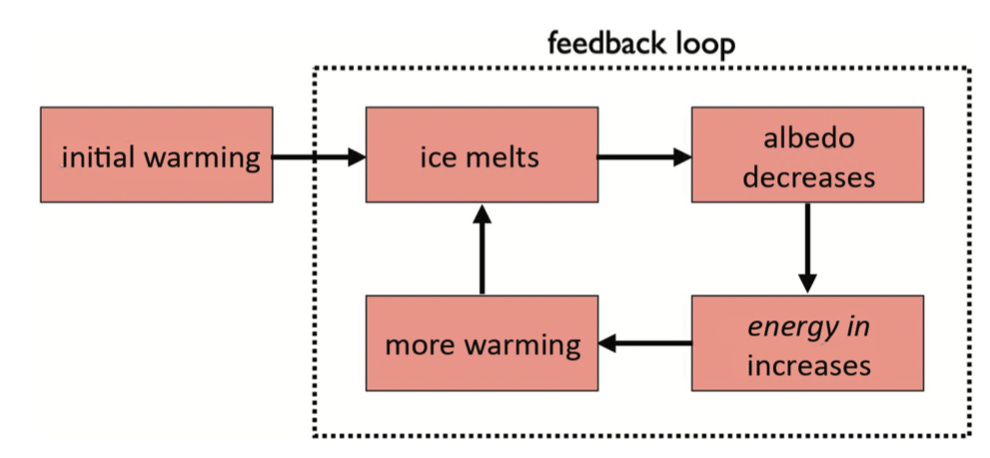
If you add carbon dioxide to our atmosphere, you get an initial amount of warming due to increased trapping of heat. If that were all there was to climate change, it would be a pretty simple scientific problem. But lots of things change in response to that warming and some of these changes can lead to additional warming. This is known as a feedback.
An example is the ice-albedo feedback. As the climate warms, you melt ice. This NASA figure shows sea ice is bright white, meaning that it is reflecting most of the sunlight that hits it. Open ocean is dark blue, meaning that it’s absorbing most of the sunlight that hits it.
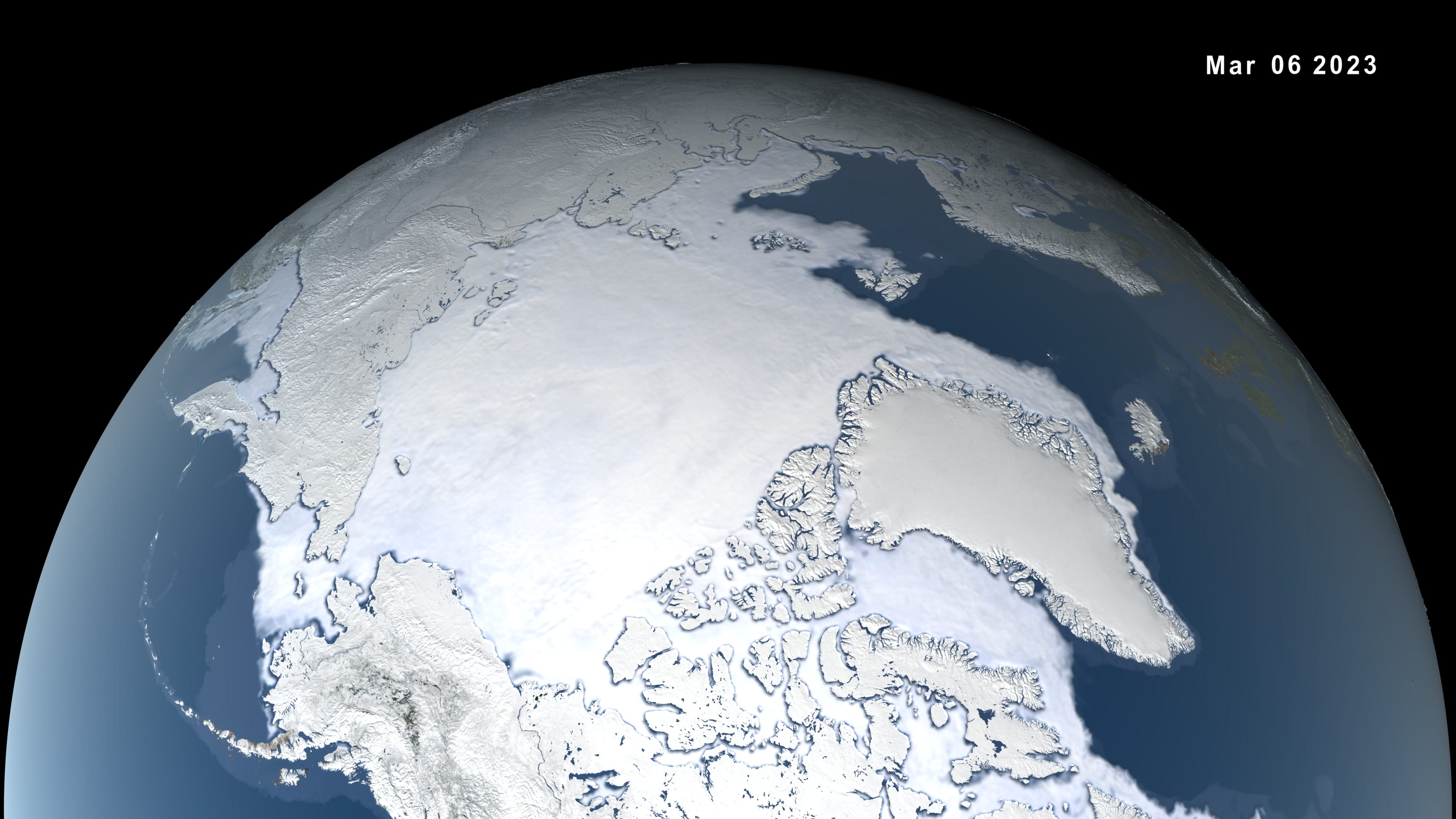
When sea ice melts due to warmer temperatures, a bright white surface (ice) is replaced with a dark surface (ocean). The net result of this change in surface reflectivity is that the Earth absorbs more sunlight.
This causes more warming, which melts more ice, which leads to more absorbed sunlight and more warming, which drives more ice melt, etc. Lather, rinse, repeat.
feedback math
To get more quantitative about feedbacks, let us first go over some basic feedback math. For any feedback, we can express its strength as f, which is the warming produced by one additional trip through this feedback loop per degree of warming from the previous trip through the loop.
Thus, in response to an initial warming ∆Ti, the first trip through the feedback loop produces additional warming of f∆Ti due to melting ice and increased absorption of sunlight.
But the feedback operates on this additional warming, producing an additional warming of f × f∆Ti = f2∆Ti. The feedback then operates on this additional warming too, leading to an additional warming of f × f2∆Ti = f3∆Ti . This goes on forever, so the final warming ∆Tf is:
The math ninjas among you will recognize this infinite series can be rewritten simply as:
the runaway condition
As long as f remains below 1, each pass through the feedback loop contributes less warming than the last, and the infinite series converges to a finite total. But when f reaches 1, every pass contributes the same warming as the one before — the series never converges, and the total warming becomes unbounded. This is a runaway climate.
The temperature won’t actually reach infinity, of course. Every feedback has a physical limit at which it shuts off. The ice-albedo feedback, for instance, stops amplifying warming once all ice has melted. The water vapor feedback stops once the oceans have boiled away and no liquid water remains. These are natural endpoints that have all occurred on Venus.
But the essential question stands: can warming on Earth ever take off on its own? Can Earth reach a runaway climate?
We know our current climate is stable — we add warming every year, and the climate hasn’t run away. This tells us that Earth’s f is well below 1. Detailed analyses of all the major feedbacks — water vapor, clouds, ice albedo, and the lapse rate — confirm this, placing the combined f somewhere between 0.5 and 0.75. A stable climate, just as we’d expect.
how it could happen
There are a few ways that have been proposed whereby the Earth’s atmosphere runs away. They mostly revolve around the behavior of water vapor in the atmosphere.
warning: you are entering the nerd zone
If the surface warms enough, the atmospheric temperature profile asymptotes to the saturation vapor pressure curve, known as a pseudoadiabat. In this state, the temperature at a given optical depth becomes fixed, regardless of the surface temperature.
Consequently, the energy out for the Earth reaches an asymptotic upper bound, known as the Simpson-Nakajima limit. If energy in for the Earth exceeds this maximum energy out, the energy imbalance cannot be corrected by a rise in surface temperature, leading to a runaway greenhouse effect2.
People have estimated the limit of energy in to be around 280-290 W/m2. Right now, energy in from the Sun is about 240 W/m2, so this suggests that it would take at least +40 W/m2 of radiative forcing to push Earth into a runaway climate state. Given that doubled carbon dioxide has a radiative forcing of +4 W/m2, +40 W/m2 corresponds to 10 doublings of carbon dioxide, a factor of 1000x above preindustrial concentrations.
It seems quite unlikely that there is anywhere near enough fossil fuels to reach this runaway threshold.
A far more plausible way for our climate to run away is a brightening Sun. Solar physicists think that the Sun is getting brighter at a rate of about 1% per 100,000,000 years. At this rate, energy in for the planet might reach the runaway threshold in one or two billion years.
so should you worry?
Not about Venus. A true runaway greenhouse — boiling oceans, hellish surface temperatures — is simply not in the cards on any time horizon we care about.
But “not Venus” is a remarkably low bar to set for ourselves. There’s an enormous amount of territory between our current climate and a Venusian apocalypse, and we’d strongly prefer not to explore it. As Jim Hansen has argued, what we should really care about is warming sufficient to break the things that matter to us — ecosystems, infrastructure, food and water security, human lives.
We’re already seeing bad things happen to those — with only 1.5°C of warming. Climate change is affecting us right now, without any runaway greenhouse in sight. That alone should be more than enough motivation to limit future warming as much as we can.
related “runaway” information
Another possible scenario for very large warming is the emergence of a strong carbon-cycle feedback: A truly worst-case climate scenario: Losing control of the carbon cycle
And, of course, clouds could do something weird.
Ray Pierrehumbert’s excellent book Principles of Planetary Climate contains several illuminating discussions of a runaway greenhouse (note: this book is at the grad school level).
other stuff
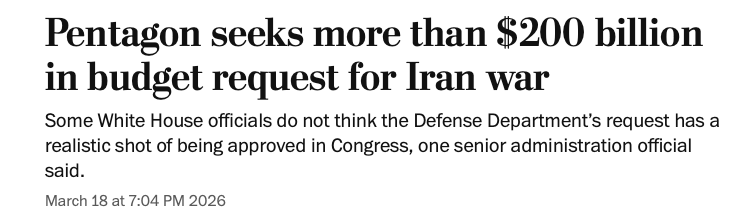
I wrote recently about the cost of fossil fuels to our national and economic security. Then came reports that the Pentagon has asked for approval for a $200 billion request to Congress to pay for the war in Iran. This is a lot of money — around $600 per U.S. resident.
This war, as well as the war in the Ukraine, are fundamentally enabled by fossil fuels. In a world of climate-safe renewable energy, it’s hard to see that these wars are being waged.
This really undercuts the “solar and wind are expensive” argument.
I’d be grateful if you could hit the like button ❤️ below! It helps more people discover these ideas and lets me know what’s connecting with readers.
Hansen uses ‘runaway’ in a few different contexts in that post — most relevant to him was the definition of pushing the climate beyond a “point of no return,” e.g., locking in irreversible changes like ice-sheet collapse. As Hansen says, this is slightly different than what is normally meant when talking about a runaway climate and is what I would refer to as a tipping point.
One way to think about this is that the water vapor feedback’s f reaches or exceeds a value of 1.
Thanks as always! I worry about the effects of climate on future agriculture. The planet already has lots of hungry people, and current agricultural practices are destroying our soil. Add in the effects of climate change, and I think we are in real trouble!
Great elaboration by Andrew and his explanation of Dr Hansen's intent. Andrew alludes a good point.. we can do everything right to reverse climate change but war will still feed the beast.