

Imagine if I told you that the damages from climate change next year are worth 12% less to me than climate damages today. And 12% less the year after that. That the harms from climate change on people alive in the year 2100 are only worth one fiftieth as much as impacts on people this year. You’d probably call me selfish, heartless, or a similar slew of invectives, and rightly insist that the welfare of future generations should not be sacrificed for my short term benefit.
But a somewhat obscure climate policy choice of how to value methane emissions compared to CO2 is doing just that – and unfortunately a number of climate scientists who should know better are defending it.
The broader context is a big fight at the moment over proposed revisions to New York’s state climate law. Governor Hochul is proposing both delaying the implementation of the law (which in my opinion is not a good thing), and changing the way that methane is treated by using a 100-year timeframe rather than a 20-year one. It is my opinion as a climate scientist that using a 20-year timeframe is deeply problematic – and I’m far from the only one in the community with that view. In this piece I’ll try and explain why.
Stocks and flows
To understand why the timeline over which methane is compared to CO2 matters, we first need to understand the different climate effects of the two gases. I’ve written about this at some length in the past, but here is a short summary.
Methane is relatively short-lived, with a lifetime of around 10 years. But while it is in the atmosphere it has a very strong climate effect, trapping on the order of 100x more heat than CO2 for every ton. Methane is short-lived because it oxidizes in the atmosphere, breaking down into CO2 and H2O through a long chain of chemical reactions catalyzed by interactions with OH radicals.
CO2, by contrast, is extremely long-lived. The mean atmospheric lifetime is on the order of 10,000 years, though this is dominated by a very long (~400k year) tail associated with silicate weathering. On shorter timescales around 60% of a pulse of emissions is absorbed by land and ocean carbon sinks within a century of emissions (though the strength of these may change as a result of our changing climate).
These different lifetimes mean that methane does not accumulate in the atmosphere over longer timeframes, while CO2 does. Methane is a “flow pollutant”, in that its climate effect is a function of the rate of emissions, while CO2 is a “stock pollutant” whose impacts are a function of cumulative emissions.
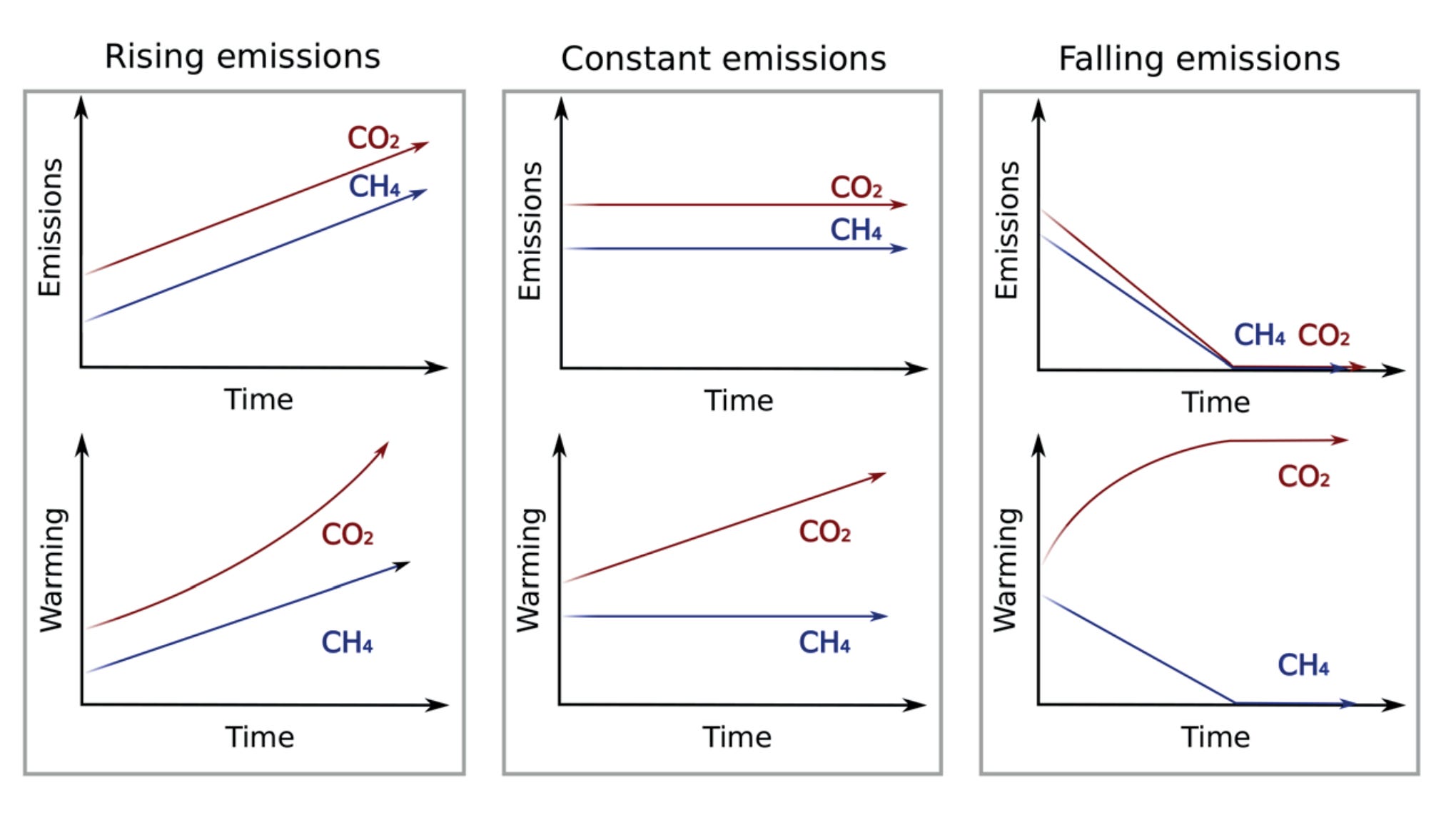
If emissions of methane increase, we get warming. If they stay flat, their temperature effect is constant, while if they decline we get cooling. CO2 emissions, on the other hand, always warm the planet. Increasing CO2 emissions cause warming to speed up, flat CO2 emissions cause steady warming, and decreasing CO2 emissions slow (but do not stop) warming. The only way to get cooling with CO2 is to actively remove past emissions from the atmosphere.
Short-term benefits and long-term harms
Global warming potentials (GWPs) are a useful metric to convert different types of greenhouse gas emissions into a single unit, generally expressed as a CO2-equivalent (or CO2e). They are defined as the amount of a gas needed to trap the same amount of heat in the climate system as CO2 over a specified timeframe – commonly 20 years, 100 years, or 500 years.
However, while convenient, they are not necessarily physically meaningful. I cannot tell you how much warmer the world will be in 20, 100, or 500 years based on a certain amount of CO2e.
To illustrate this, let’s look at the climate effects of reducing emissions by one gigaton of CO2e each year for 20 years. The blue line shows the effects of reducing CO2. Here global temperatures are reduced by around 0.01C, and this cooling benefit persists more or less indefinitely (at least on timescales of millennia).
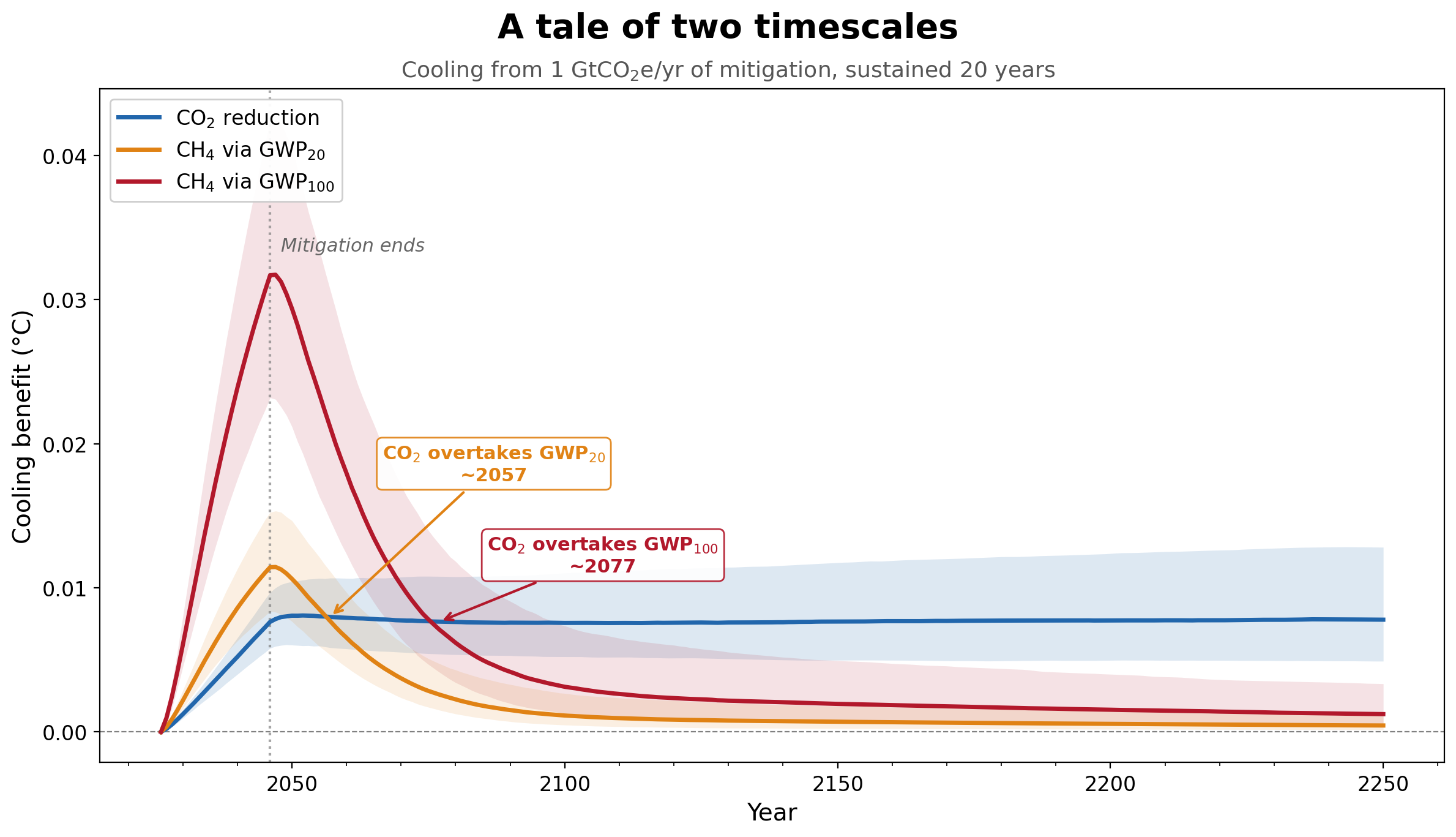
If we cut the same amount of “CO2e emissions” in the form of methane using a 100-year period for GWP calculations, we get the red line. We get much more short-term cooling, reflecting the more powerful heat-trapping effects of methane. But the climate effects fade away over time, and after 100 years or so only a fraction of the cooling remains.1 This is often justified by the fact that short-term cooling is so much larger, so the “area under the curve” between methane (GWP100) and CO2 mitigation is quite similar, for at least a century or so.
If we use a 20-year GWP period to compare methane and CO2, we get the worst of both worlds. Not only does the cooling benefit of methane mitigation not persist, but it’s not that much greater than CO2 during the period of emissions. This is because we need to cut a lot less methane (only around 12.1 megatons per gigaton of CO2) when using GWP20 compared to a much larger reduction (33.6 megatons) when using GWP100.
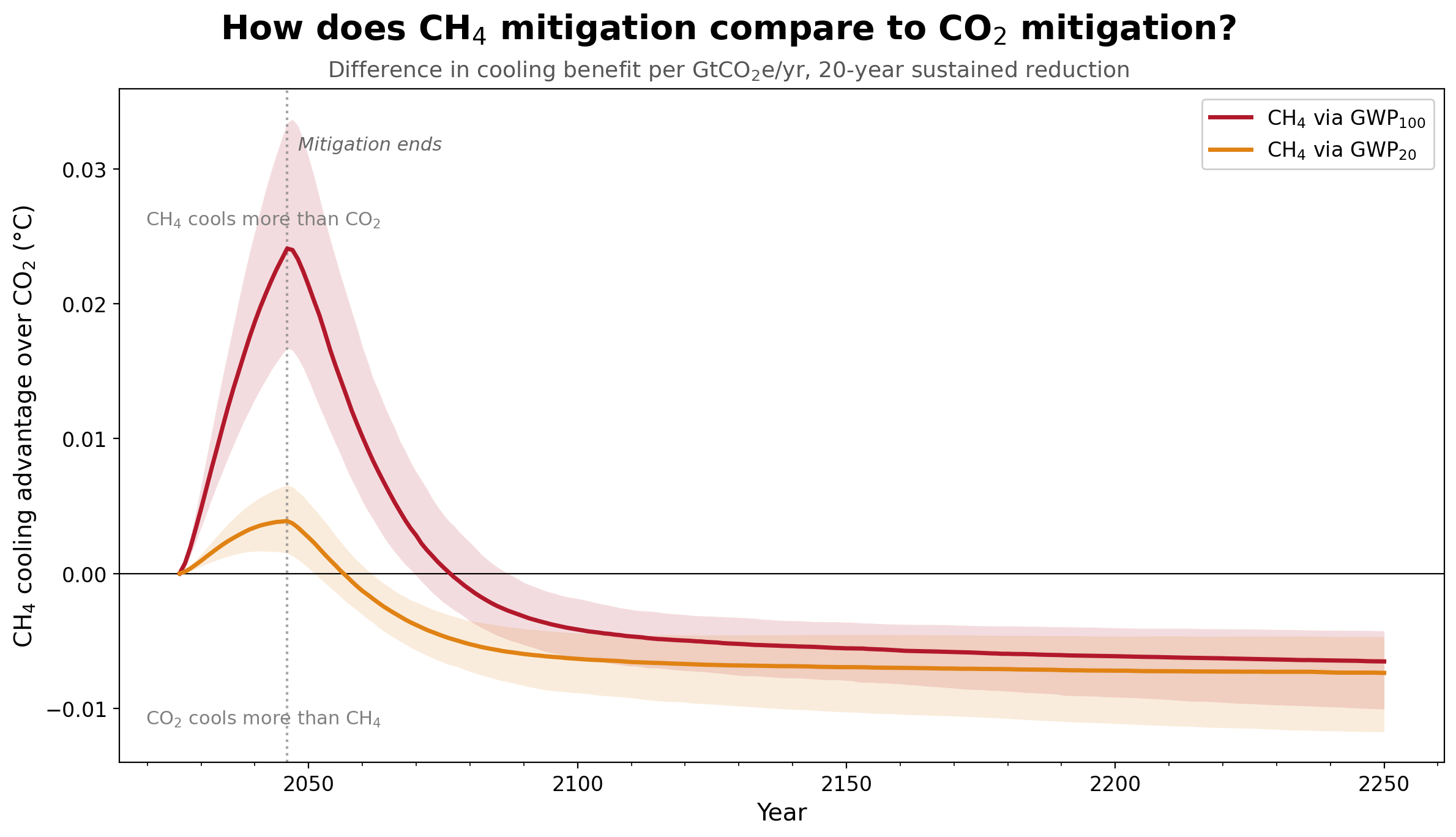
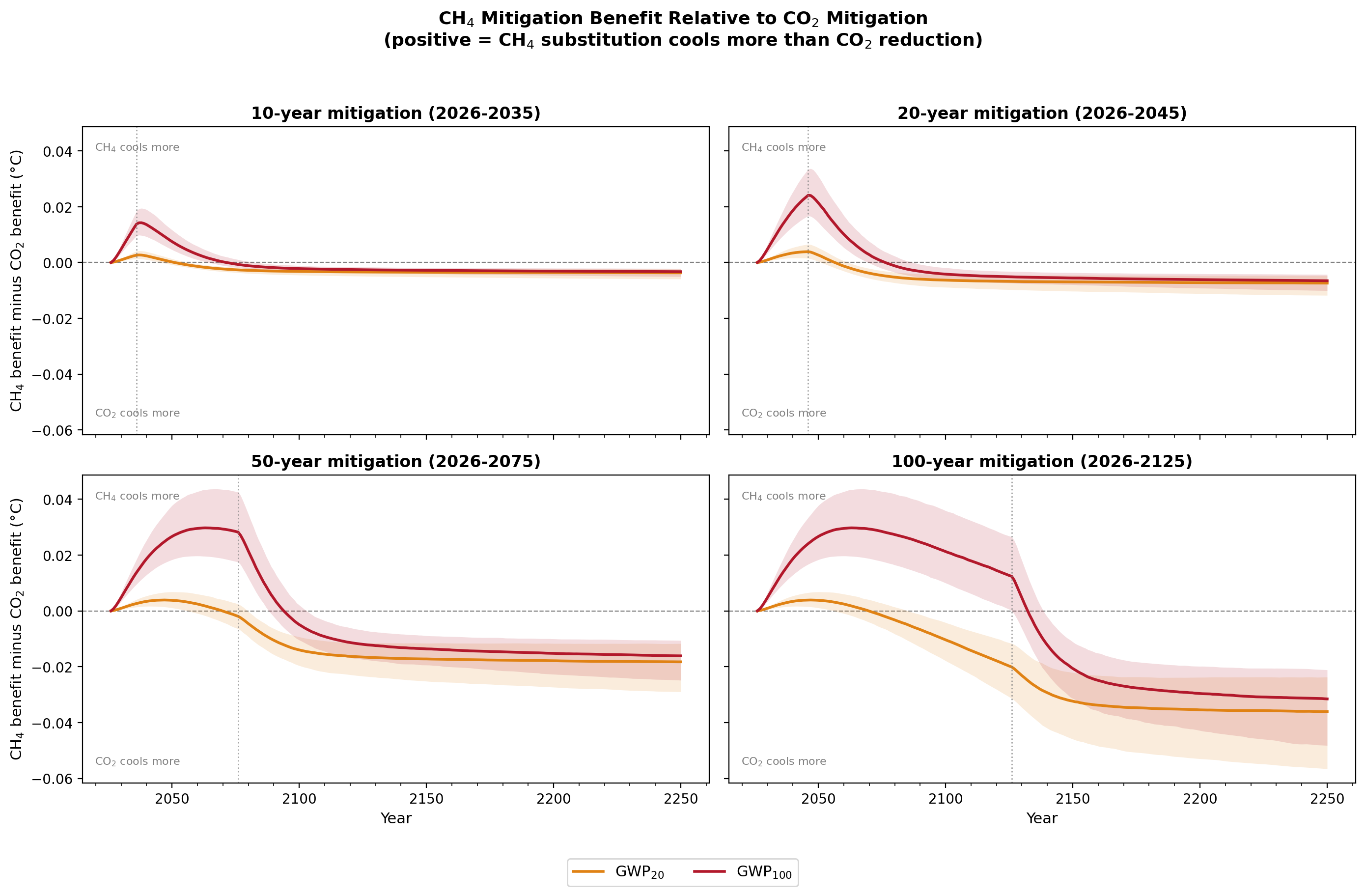
We can also more directly look at the difference in global temperatures over time if we chose to mitigate methane emissions instead of CO2 emissions. In the figure below, values above zero reflect periods when we get more cooling from methane reductions than from CO2, while values below zero show periods where CO2 reductions give us a bigger climate benefit. Here the GWP100 metric provides at least some period of climate benefits, while GWP20 only gives a very short term boost.
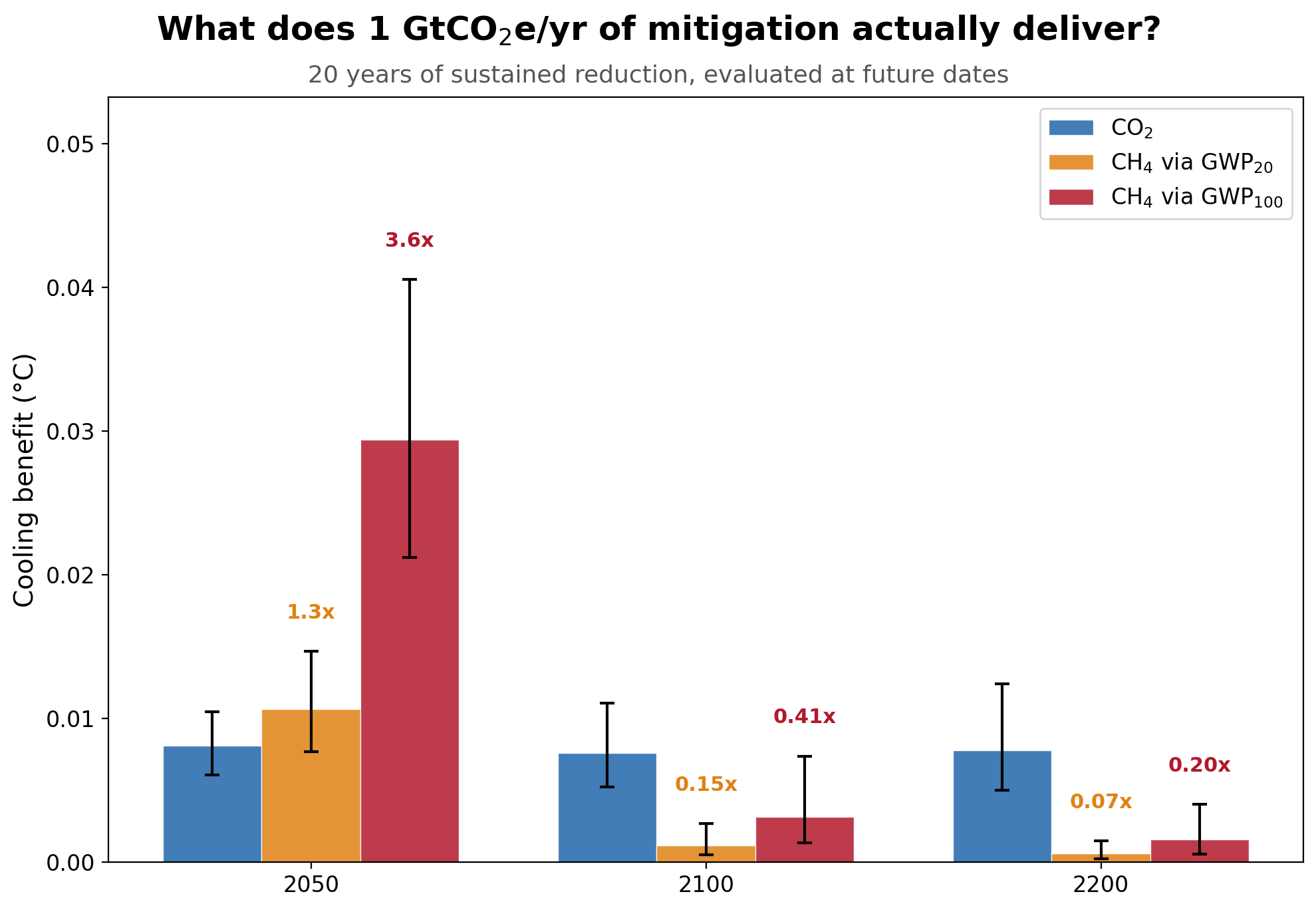
Similarly, if we look at the effect on global temperatures in 2050, 2100, and 2200 we find a large benefit (3.6x more cooling than CO2 mitigation) of methane in 2050 using GWP100, and a small benefit (1.3x) when using GWP20. By 2100, however, methane using GWP100 only gives us 40% of the cooling as CO2 reductions, while methane using GWP20 is a measly 15%.
Even if we sustain methane and CO2 reductions for longer than 20 years, methane with either GWP20 and GWP100 eventually ends up with higher warming than CO2. For GWP20 this occurs after around 40 years, and after 135 years for GWP100.
Discounting the future
How we choose to value the short-term benefits of methane reductions compared to the long-term harm of CO2 is ultimately a question of how much we value the future compared to the present. This is not a new question; the economics literature has long explored how to answer this question using the concept of “discount rates”.
In fact, the choice of time horizon for determining the equivalence between CO2 and methane can be directly translated into an effective discount rate based on how much near-term climate damages you avoid at the cost of greater longer-term harm. A 2018 paper by Marcus Sarofim and Michael Giordano found that GWP100 is equivalent to a 3% discount rate – similar to what governments use for long-term infrastructure investments. GWP20, by contrast, translates into a discount rate of 12% per year, which is much higher than almost any discount rate used for policy decisions today.2
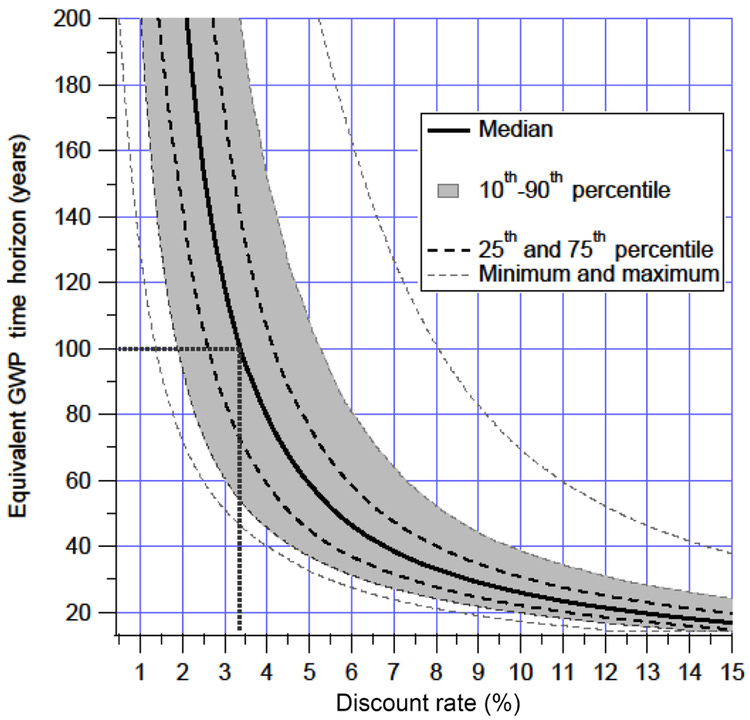
A 12% discount rate means that the same level of climate impact to a person alive 100 years from now is only worth 2% as much as it is today. It represents a deep discount of the welfare of future generations, and is fundamentally at odds with our goal of stabilizing the climate under the Paris Agreement.
So why do people advocate for GWP20?
If heavily discounting the future is so deeply inconsistent with the concern for the welfare of future generations usually espoused by climate advocates, why do we see people making the case for GWP20?
There are a few reasons. One major one is a concern over near-term climate harms, particularly the possibility of tipping points in the climate system. If the world is likely to cross a critical threshold in the coming decades, then wouldn’t it be critical to prioritize short-term cooling of the climate, even if it might come at the expense of longer-term warming?
This argument misses the mark for a number of reasons. First, most of what we call “tipping points” are not instantaneous changes between climate states, but rather reflect feedbacks with hysteresis. That is to say that it does not just matter if we pass a particular temperature level, but rather how long we pass that level is critical. The temporary cooling associated with substituting methane reductions for CO2 reductions will only avoid these impacts if it’s followed by some additional measure to keep global temperatures down. If we end up with more warming long-term by prioritizing methane mitigation over CO2, the risks of tipping points will increase rather than decrease.
Second, the risk of tipping point exceedance is linked to the peak level of warming, which will not occur until the latter half of the 21st century even under ambitious mitigation scenarios. Methane mitigated today will have a minor impact on temperatures in a world where warming peaks in 2070, while CO2 will have a much larger impact.
The other argument for using GWP20 is to ensure that we get more methane mitigation than we otherwise would, and specifically reduce the use of natural gas (which involves both CO2 emissions when combusted and methane from leaks). But the use of GWPs by definition introduces a tradeoff between methane and CO2 when used in the context of a climate target measured in CO2e. If New York wants to cut its emissions by 40% by 2030, using GWP20 will make it a lot cheaper to achieve that goal by cutting methane than by cutting CO2 because it means that methane counts a lot more than CO2 toward that goal. While we might ultimately end up with (net) zero CO2 and methane emissions under a net-zero target, the path we take to get there matters a lot for temperature outcomes.
A better path forward
It is important to take measures to cut methane emissions and it provides real, tangible benefits in the near-term. But there are ways to design systems that do not come at the cost of the welfare of future generations.
If we want to stick with traditional GWPs as a framework (and ideally we should not), using GWP100 is much more justified than GWP20 as it aligns with the level of future discounting (~3% per year) that we currently apply to a lot of other long-term investments in public welfare. However, GWP100 still is not well aligned to the goal of temperature stabilization given the long-term differences in climate outcomes.
There are alternative metrics like GWP* that compare flows of methane to stocks of CO2 rather than treating the two as directly equivalent, as well as simple to use climate models that can allow policymakers to determine the actual temperature effects of their decisions over time.
But the simplest approach – and one increasingly espoused by the climate science community – is to avoid conversions altogether by setting separate targets for CO2 and short-lived climate pollutants like methane. Rather than having a goal of reducing the (not-physically-meaningful) “CO2e” emissions 40% by 2030, set separate goals for both CO2 and methane. That way we know what we are getting, and we don’t create the problem of having to trade off between the two.
I’d be grateful if you could hit the like button ❤️ below! It helps more people discover these ideas and lets me know what’s connecting with readers.
This remaining cooling is a combination of the oxidation of methane into CO2 (at least for fossil methane emissions; the CO2 from biogenic methane is not additive as it would have been released in the absence of methane formation) and ocean buffering of global mean surface temperature response.
Other papers in the literature find similar values; Mallapragada and Mignone (2019) also finds that GWP100 is equivalent to a discount rate of 3%, and that GWP20 equates to a discount rate of >7%.
I appreciate the write up Zeke, to disambiguate this funky calculation problem, the effects of which are (perhaps) more irritant than reality (?). The reality is we need to reduce emissions and remove CO2 and CH4 / convert CH4 (ISA) as fast and as much as possible, which continues to slide downward on a diminishing hope slope (yeah, I said hope slope). The reality is they are different gases with different dynamics, so treating them differently makes good sense. Recommending a different framework than the CO2e gwp20 vs gwp100 is in line with what my grandmother told me many years ago: stop touching me.
I was not that keen on the title or some of the write-up until we get toward the end: namely that Methane and Carbon Dioxide should be treated separately, as there really is no equivalent and the GWPs can be quite misleading. The conflict is highlighted by the fact that methane has a lifetime of 10 years or so (e-folding) - so it is all gone in about 20 years - and the use of a 100 year time frame for GWP.
It is also very important to separate out fossil methane from biogenic methane. The latter is circular (starts as CO2, goes into grass and plants, is eaten by animals and converted to methane, that ends up as CO2), while fossil methane contributes to more CO2.