

This week I listened to a fascinating Catalyst episode with Olya Irzak of Frost Methane, which featured the eye-opening estimate that 50 GW of new behind-the-meter gas could result in 380 million tonnes of CO2-equivalent over 18 months once methane leaks are taken into account.
This is a real problem. In their rush to power data centers are building the least efficient fossil gas generation, often with high equipment gas leakage, many of which are located in gas production regions that are in turn characterized by high leakage rates.
But its also a problem with a reasonable achievable near-term solution: if we are going to build data centers, we should ensure that they are connected to the grid rather than building dirty off grid gas generators. But to make this case, its important to understand just how much worse off-grid gas turbines are from an emissions standpoint, as shown in the figure below:
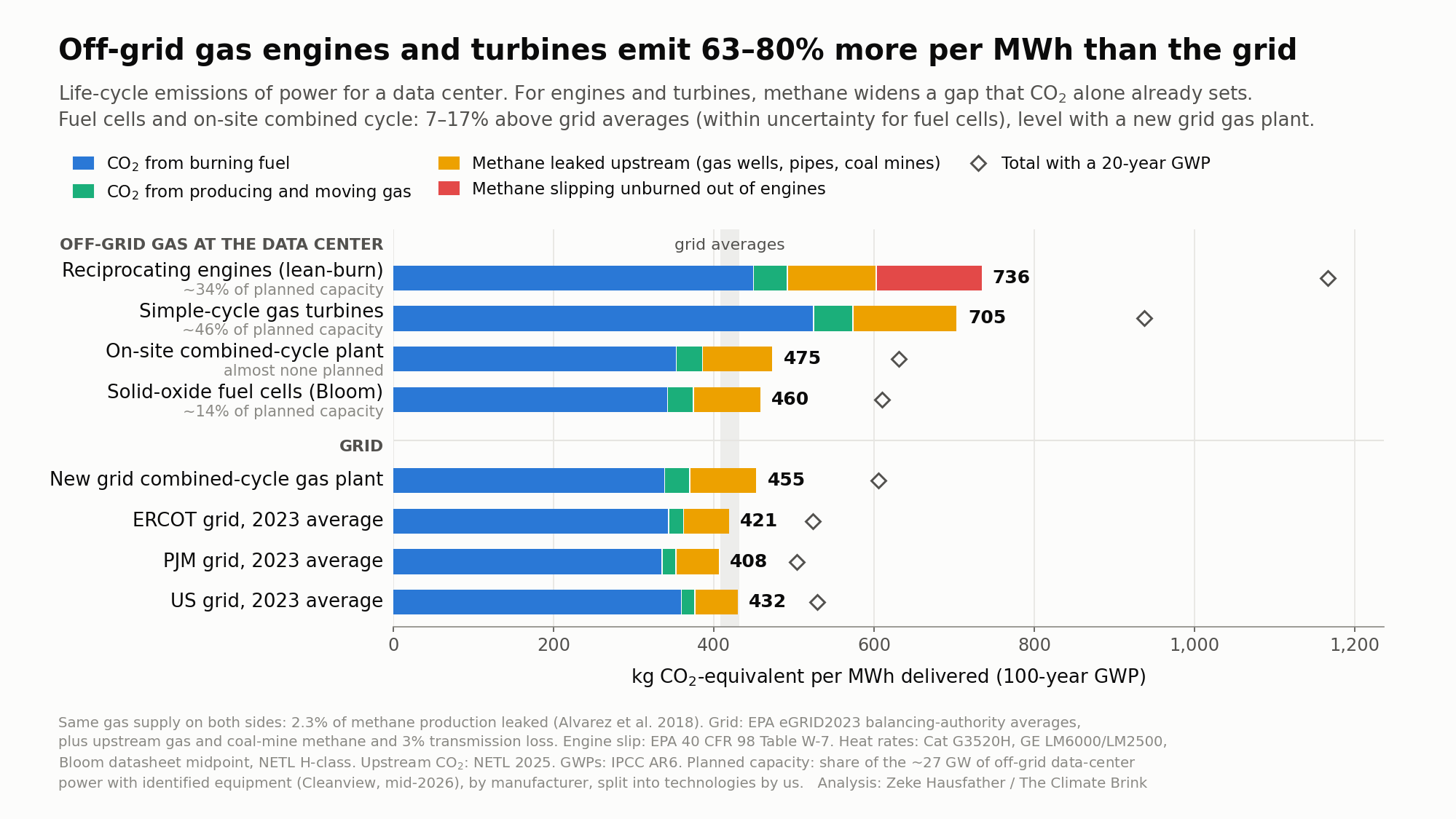
Here we examine four potential gas combustion technologies that off grid data centers could use. According to Cleanview’s tracker, simple-cycle turbines are planned for around 46% of off-grid data centers, reciprocating engines ~34%, fuel cells ~14%, unattributed generation around 6%, and on-site combined cycle plants effectively 0% today. These values are weighted by planned datacenter size, but only ~30% of planned capacity has identified equipment, so take these numbers as directional rather than precise.
The calculations here are also a bit generous to off-grid gas, as they use a nation-wide average 2.3% of methane production leaked upstream of generation based on Alvarez et al. 2018 (though more on that assumption later!). The grid numbers are 2023 averages from EPA’s eGRID for ERCOT, PJM and the US as a whole. They include the grid’s own upstream gas leaks, coal-mine methane and 3% transmission losses, all of which push the grid number up. Engine slip comes from EPA’s reporting factors for lean-burn engines, about 2.8% of the methane going in.1 Heat rates come from manufacturer data sheets for the equipment showing up in Cleanview’s tracker of behind-the-meter projects.
Reciprocating engines come out at about 740 kg of CO2-equivalent per megawatt-hour (MWh) and simple-cycle turbines at about 705. That is 63 to 80% more than average grid power in ERCOT, PJM or the US. Methane leakage (including engine slop) adds between 70 and 190 kg per MWh to that gap. But even without methane leakage the gap would be large; on CO2 alone, engines and turbines are 31% to 63% above the grid, because they are quite inefficient at turning gas into electricity.
There are more efficient options that are closer to grid emissions, but these are much more rarely installed today given longer build times or lower equipment availability. Fuel cells (mostly Bloom’s, which represent about 14% of identified behind-the-meter capacity in Cleanview’s data) and an on-site combined-cycle plants only emit 7% to 10% more than the US grid average, and are similar to what a utility would build to serve the same load.
That being said, US electricity grids are decarbonizing over time with the rapid deployment of clean energy. Existing gas that is grid connected can reduce capacity factors when low-cost renewable generation is available in a way that off-grid generators cannot (at least unless they also build on-site renewables or grid connect in the future). There is a real risk that off-grid gas generators become locked in over long periods of time while the rest of the electricity generation system decarbonizes.
Emissions also depend on where the data center is
Off-grid projects are clustered in a few specific regions, and both the local grid and the local gas supply differ a lot in terms of generation mix and leakage rates. So I reran my comparison for seven different datacenter hotspots in Cleanview’s tracker. For each region I used the 2025 grid average from EIA’s hourly grid data (counted on a consumption basis so that imported power is included). Each region also gets an upstream leakage rate for both on-grid and off-grid gas generation measured in the gas basin most likely to supply it, which are measured from aircraft and satellite surveys (e.g. MacKay et al. 2026, Varon et al. 2026, and others).2
The figure below shows how each option compares with the local grid average:
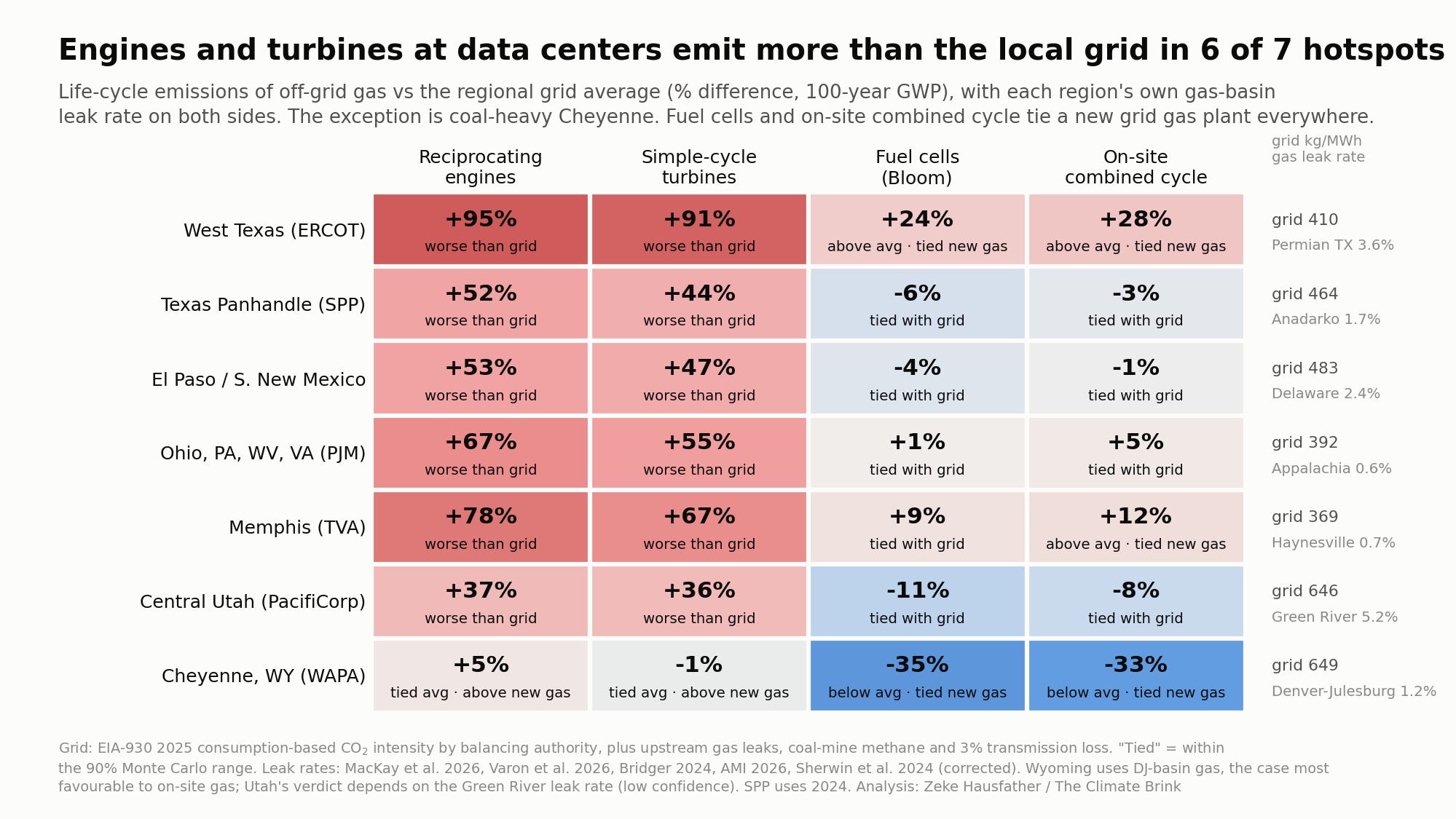
Engines and simple-cycle turbines emit more than the local grid in six of the seven regions, by between 36% and 95%. The exception is Cheyenne, Wyoming, where coal still generates nearly 60% of the grid’s power. There, engines and turbines are comparable to the grid average, but they still emit 55% to 64% more than a new gas combined cycle plant on the grid would. Large new loads can also delay coal plant retirements, which would make plugging into that grid worse than its average suggests.
So what is the path forward here?
Engines and turbines off-grid are the most polluting way to power new load in six of the seven hotspots where data centers are being built today. Fuel cells and efficient on-site plants are roughly as bad as building new gas on the grid, but relatively few data centers are planning on building them near-term.
Data center developers would generally prefer to connect to the grid than build their own off-grid systems. Off-grid systems require more redundancy and higher costs; low-efficiency gas generators or turbines run constantly are very expensive (and high emissions) form of generation. But in many cases its the only option they have, as the timelines associated with getting grid connections are too long or there simply is not sufficient generation available on-grid.
Ultimately we need to make our grids more robust – with new generation met by low-carbon energy sources, a modernized transmission grid, and lots of grid-scale storage – if we want to avoid a world where massive amounts of islanded gas generation gets built in the coming decade. In the meantime we should ensure that any off-grid data centers that are built meet existing air pollution regulations, encourage them to supplement gas with on-site solar and storage, and pursue broader efforts to reduce gas leakage (many of which, unfortunately, have been recently rolled back by the Trump administration).
In case its helpful, I’ve put the code and data to reproduce this analysis on my GitHub here.
Engine slip (often called methane slip) is fuel gas that passes through an engine without burning and leaves in the exhaust as methane. In reciprocating engines, some of the fuel-air mixture gets trapped in small gaps around the pistons where the flame can’t reach. Some also blows straight through while the intake and exhaust valves are both open. The lean fuel mixtures these engines use to cut NOx also burn less completely. EPA’s reporting factors for four-stroke lean-burn engines works out to about 2.8% of the methane going in, while modern gas turbines leak only around 0.02%. Running engines at partial load also can raise slip, and Olya Irzak said she has seen measurements as high as 12%, though most off grid data centers are expected to have relatively high capacity factors.
Note that for accounting purposes all gas leakage in a basin is being counted against gas production in the basin rather than being counted against oil production, even if the gas produced is associated with oil production.
Good post. At the same time, the case for data centers to invest in the grid instead of doing their own generation has been clear even without the climate context, as Michael Liebreich explained on Sustain What https://revkin.substack.com/p/michael-liebreich-on-how-ai-giants?utm_source=publication-search
I'd agree it's a real problem if someone could quantify the impact on GW.